A Language Project in Practice – Ragdres Yeth yn Praktis
11 September to 11 October 2026
Dydh da.
Nine months into this project, Cornish is beginning to occupy a different place in my life.
Whilst, the daily practice continues. I still forget words, repeat lessons and hesitate over grammatical forms. However, this month I also put posters up around Exeter, joined an online conversation group and sat in a café speaking Cornish with someone who had responded to the ad.
These developments have made the relationship between learning and speaking feel a little more real. I am now creating occasions where I want to speak Kernewek live, in the flesh as it were.
Keeping the Language Available
Much of my formal practice this month involved consolidation.
Working through the old Say Something in Welsh Level 3 course while responding in Cornish gave me repeated practice with short verb forms. Some came readily; others required more thought. When a short form was unavailable, I could usually use a longer construction and keep going. And this flexibility seems to be useful.
Vocabulary remains less dependable. Revisiting my earlier blog posts reminded me of words I had once used quite confidently but could no longer retrieve immediately. Towards the end of this month, a revision lesson produced much the same experience: the grammatical structures were reasonably secure, but individual words had slipped out of reach.
The blog is therefore becoming a resource for learning as well as a record of it. There is language in these posts that I need to recycle.
Returning to the Beginning
Towards the end of September, I returned to the original Say Something in Cornish course.
Part of the reason was nervousness. People were responding enthusiastically to Kernewek yn Karesk, and some were writing to me in very good Cornish. I was pleased, but also suddenly conscious that I was inviting people to speak a language I am still learning myself.
Going back to earlier lessons seemed sensible.
The vocabulary was mostly familiar, which gave me space to notice grammatical patterns I had not been using quite accurately or confidently. More surprisingly, I began understanding familiar material in new ways.
The connection between omlowenhe, “to enjoy oneself”, and lowen, “happy” or “joyful”, suddenly became clear. Other constructions began to make more sense through what I had learned about the verbs behind them.
I was returning with several months of additional experience from reading, listening and other courses. The lesson was familiar, but my understanding had changed.
Welsh as Help and Habit
Welsh continues to provide useful connections.
Related words and familiar endings often make Cornish easier to remember. Recognising parts of a word also helps. Vocabulary becomes more manageable when I can see how it is put together.
But Welsh influences what I produce as well as what I understand.
During our second Exeter meeting, Pol ( pseudonym) corrected my pronunciation of du, “black”. I had been carrying the Welsh vowel into Cornish. It was a small correction, but a useful reminder that something can feel entirely familiar and still need attention.
Listening more widely has helped here too. I listened to all twelve episodes of the BBC Learn Cornish podcast and followed the lyrics of Gwenno’s songs. Differences between speakers increasingly interest me, and more words and structures are becoming recognisable when I hear them.
Cornish is gradually acquiring a range of voices in my mind.
An Unpredictable Conversation
On 28 September, I joined an online Cornish conversation group for around an hour and a half.
The other participants were proficient speakers, and I was very aware of the difference between their spoken Cornish and mine. I could contribute to some extent, but at one point I could not understand a question and we briefly switched to English.
I came away with mixed feelings.
I had enjoyed listening to Cornish being used naturally and had managed to make myself understood. Yet my speaking felt less comfortable than it often does during a lesson.
The experience reminded me of my early attempts to speak Welsh after working through SSIW. In a course, I know the context and can anticipate the sort of response required. In conversation, somebody can ask something I have not prepared for at all.
That changes the task considerably.
I have to understand, decide what I want to say and retrieve the language while the conversation continues around me. More lessons may help, but I also need experience of doing precisely that.
I intend to carry on.
Kernewek in Exeter
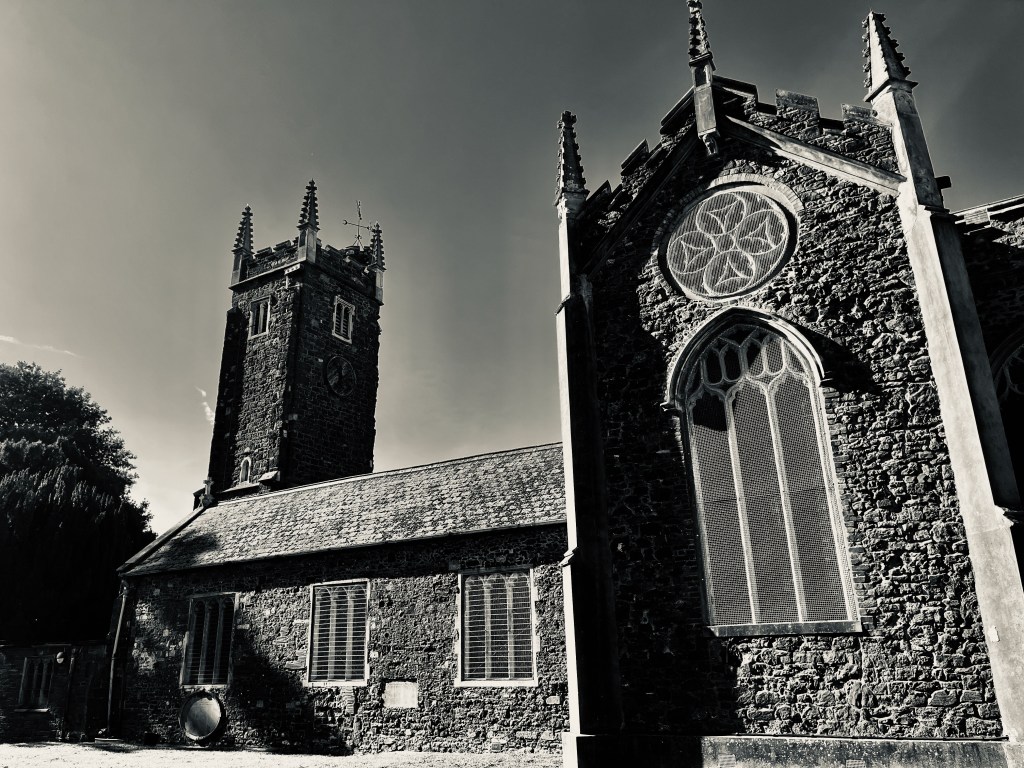
Eglos Sen Tommas, Karesk – St Thomas Church, Exeter. Photo – author’s own
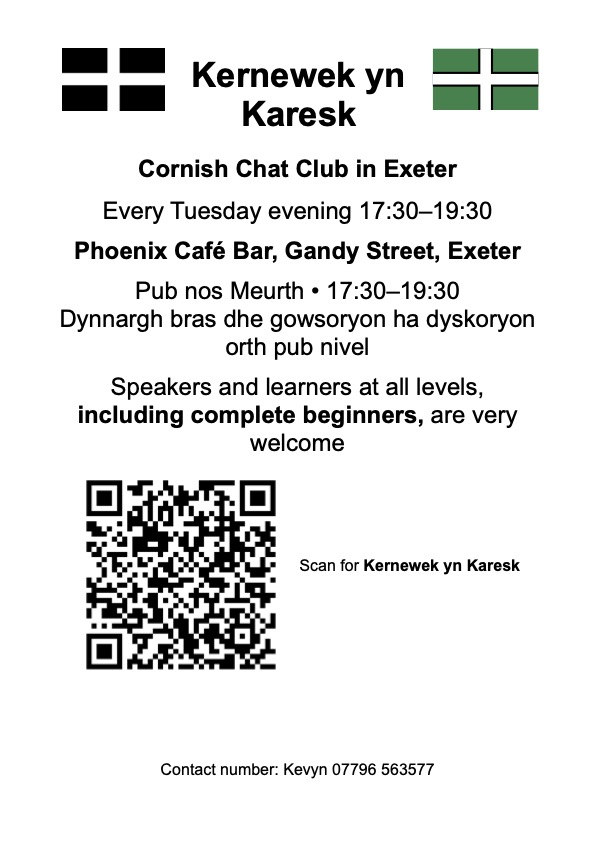
Kernewek yn Karesk became a practical reality this month.
I worked on the poster, incorporated the Cornish and Devon flags and made clear that complete beginners would be welcome. Putting posters up in supermarkets was a modest step, but it meant the invitation had finally left my computer.
The first meeting took place on 29 September.
There were two of us. We spoke some Cornish, although much of the conversation was in English. Pol had a good range of vocabulary, but also described finding spoken use difficult.
That made the purpose of the group feel clearer. We both needed somewhere to practise.
At the following meeting, we spoke considerably more Cornish.
However, the group is still small, and establishing something regular will take time. Nevertheless, other people have expressed interest, and there is now an actual place and occasion for Cornish conversation in Exeter.
Earlier in the month, I walked around the city looking for connections with Cornwall and its wider Brythonic past. That helped me think about the local setting for the group. Now I am beginning to discover who might want to use Cornish here today.
Funnily enough, Pol turned out to be a historian. We discussed the Prayer Book Rebellion of 1549 and its connection with St Thomas Church, pictured above. Its vicar, Robert Welshe, a Cornishman, was hanged from the church tower following his involvement in the rebellion.
A Resource Taking Shape
I have also started developing a small learning app, Kernewek yn Praktis.
The idea grows out of the active recall practice I have been using throughout this project: see a prompt, try to say the Cornish aloud, reveal a model answer and assess how readily it came.
It is still at an early stage. I have been developing the first lesson, and Matt from the Aberplymm group has kindly agreed to help check its language.
That review matters. My experience as a learner can help shape the practice, but I also need knowledgeable speakers to scrutinise the content.
Alongside this, short AI-assisted practice sessions have helped me formulate language connected with my own life. Cornish transcription remains unreliable, so I have been typing responses. This provides useful writing and retrieval practice, although speaking with another person brings demands that these exercises do not reproduce.
Nine Months In
This month has made my remaining difficulties more visible.
Vocabulary still needs recycling. Some negative constructions need attention. Conversation can expose gaps that a familiar exercise allows me to overlook.
But I now have more opportunities to work with those difficulties.
There is an online group I can return to, a local meeting where I can try again and people willing to help with a resource for other learners.
I am still learning Cornish. I am also beginning to make room for it in everyday life.
Perhaps the most encouraging moment this month was simply sitting down with Pol for a second meeting and speaking more Cornish than we did the first time.
Meur ras!
Month 9 Vocabulary
Some words and expressions encountered or revisited this month:
- kuntel: to collect
- treghi: to cut
- mos: to go
- dos: to come
- kavos: to have or get
- lowen: happy or joyful
- omlowenhe: to enjoy oneself
- du: black
- gweth: worse
- gwethhe: to worsen
- gortos: to wait
- gortos rag: to wait for
Research Note – Month 9
11 September to 11 October 2026
Learning stage
Consolidation continues, with a growing emphasis on retrieving existing knowledge during interaction. Revisiting introductory material reveals both residual uncertainties and a deeper understanding of previously practised structures.
Linguistic development
Short verb forms are becoming more familiar, while alternative constructions help sustain production. Vocabulary retrieval remains variable. Word formation and cognates support recall, but Welsh influence can also persist in pronunciation.
Learning strategies
Repeated course practice, listening, retrospective grammatical understanding and personally relevant prompts increasingly complement one another. Earlier journal and blog entries offer material for recycling vocabulary.
Community participation
Joining an online conversation group and launching Kernewek yn Karesk create opportunities for spontaneous use. More Cornish was spoken at the second local meeting, suggesting that familiarity and repeated contact may help participation.
Affective development
Contact with proficient speakers and responsibility for organising a group can heighten awareness of limitations. Enjoyment, encouragement and the decision to participate again coexist with this uncertainty.
Emerging research themes
- The relationship between course performance and spontaneous communication
- Vocabulary availability under conversational pressure
- Cross-linguistic support and interference
- The learner’s developing role as a community organiser
- Collaboration between learners and experienced speakers in resource creation
Provisional interpretation
Month 9 suggests that learning and participation are beginning to influence one another more directly. Interaction identifies practical needs, while revision and retrieval practice help prepare for further interaction. The local group and emerging app also extend the project into creating opportunities for other people to use Cornish.