Learning Kernewek: A Language Project, and a Research Journey
In 2026, I have decided to return seriously to learning Kernewek (Cornish). I am deliberately avoiding calling this a “New Year’s resolution”, partly because I know my relationship with Cornish has already been characterised by enthusiasm, pauses, restarts, and reflection. Rather than seeing that as a failure, I have decided to make it the point, well partly. This blog will document an auto ethnographic research project based on my experience of learning Cornish. It will explore how I learn it, why I sometimes stop, what motivates me, what frustrates me, and how different teaching approaches, materials, and varieties of the language shape that experience.
Not a beginner, certainly not fluent
I am not a complete beginner. I previously completed a short fifteen lesson Cornish course using the Say Something in Welsh methodology, which I enjoyed enormously. I have long been drawn to approaches that prioritise active recall, spaced repetition, and early speaking, with minimal explicit grammar instruction. That approach worked well for me when learning Welsh, and I found it engaging and motivating in Cornish too, although the course itself felt too short to sustain longer term progress. By contrast, I also took a more traditional Cornish course at a couple of years ago. While I value formal learning environments, and I’m a language teacher myself, I found this experience much less enjoyable. The emphasis on vocabulary organised by semantic categories, for example learning all weather types in a single lesson, felt a little demotivating at such an early stage. It did not reflect how I believe people actually acquire language, and it offered relatively little opportunity to speak, which is something I personally find crucial, even at beginner level. These contrasting experiences made me increasingly interested not just in learning Cornish, but in examining how different pedagogical assumptions affect motivation, confidence, and persistence.
Courses, books, and community
Alongside courses, I have been exploring different learning resources. I am currently working with an extremely useful Cornish course, Desky Kernôwek Bew (DKB), created by Daniel Prohaska and very kindly made available for free. DKB uses a methodology similar to Say Something in Welsh (SSIW) and consists of twenty six lessons. I have also been using two textbooks. The first is Bora Brav by Polin Prys, which I find accessible and engaging. The second is Desky Kernowek by Nicholas Williams, which I see more as a reference grammar than a learner friendly textbook. I have also begun to engage, cautiously, with the Cornish speaking community. There is a group of learners and speakers who meet weekly in Plymouth, Aberplymm in Cornish, which I have attended once and hope to return to. However, distance makes regular participation difficult. Community access, or the lack of it, is itself an important part of this project.
Choosing a variety: Middle or Late Cornish?
One early surprise was discovering that there is not just one Cornish to learn. Learners are often faced with a choice between different revived or reconstructed varieties, particularly Middle Cornish, roughly from 1200 to 1600, and Late Cornish. After some exploration and a lot of confusion, I found myself gravitating towards Middle Cornish, especially in terms of pronunciation. This was a practical decision, because as a Welsh speaker, Middle Cornish felt closer to me and reduced the cognitive load involved in trying to produce the language aloud. That choice, and the fact that learners must make such choices at all, raises interesting questions about authenticity, comfort, confidence, and prior linguistic experience, particularly for learners who already speak Welsh.
Why Cornish? Why now?
So why Cornish, and why the stop start history? I am learning Cornish because I love languages, because I have deeply enjoyed learning Welsh, and because I live in Devon, geographically closer to Cornwall than to Wales. I am also drawn to the idea of Cornwall, and perhaps Devon too, reclaiming its Brythonic linguistic inheritance. OK, so I’m an idealist. At the same time, I am very aware that my motivation for learning Cornish is not as strong or as emotionally grounded as my motivation for learning Welsh. Rather than ignoring that fact, this project takes it seriously. How does motivation fluctuate over time? How do pedagogy, materials, language variety, and community access shape that motivation? And how does being an experienced language learner influence expectations, frustrations, and enjoyment?
About this project
Methodologically, this is an auto ethnographic, longitudinal project. I will be using learning journals, reflections on speaking practice, notes on materials, and observations from community engagement as data. The aim is not to prove that one method is better than another, but to explore how method and learner fit operates in the context of a revived minority language. This blog will function both as a learning log and as a space for analysis. Some posts will be reflective, some more analytical, and some simply descriptive. Together, they will form the basis of a small scale research study into motivation, pedagogy, and identity in learning Kernewek. If you are interested in Cornish, language learning, minority languages, or how adults actually experience learning languages outside idealised classroom models, I hope you will find something of value here.
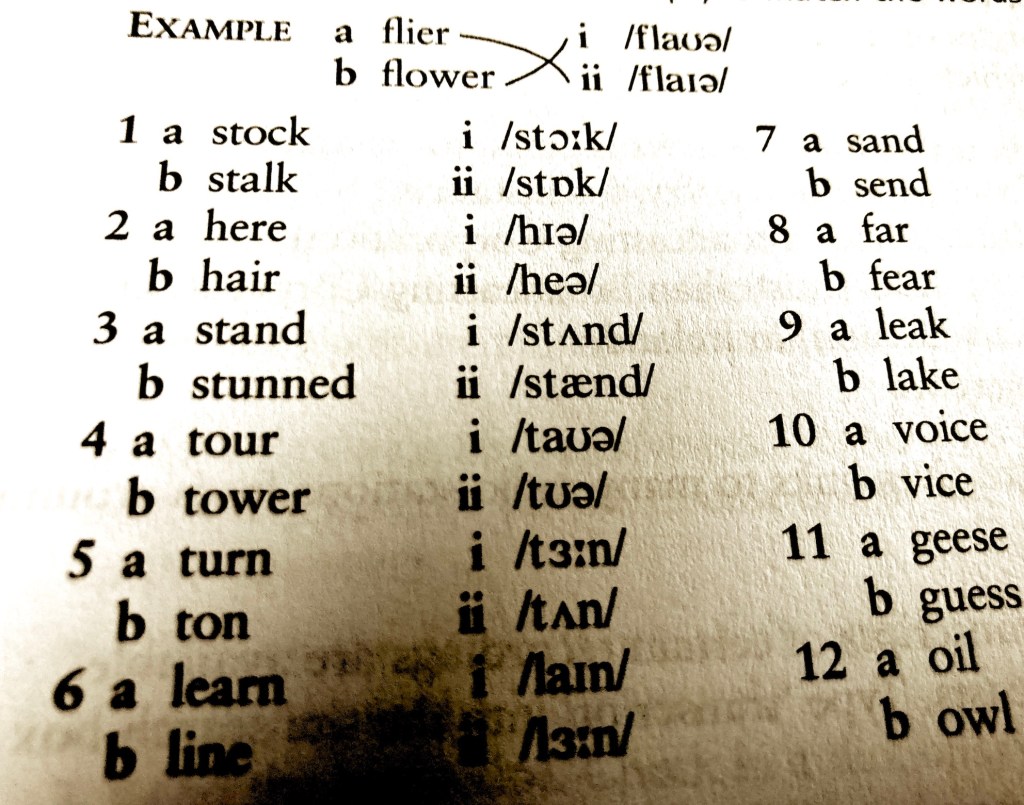
Source: English Pronunciation in Use, Advanced, Martin Hewings, Cambridge
I am often asked by students to help them improve their English accents. I usually respond that accents are only really a problem if they are a barrier to communication. That is if they prevent people from understanding the speaker. However, this answer rarely satisfies those students who are self-conscious about their English language skills. Different first languages tend to have different impacts on the way non-native speakers pronounce English. I will look at different languages’ influence in greater depth over the next few weeks, but for now, I will provide a brief introduction to the subject.
The impact of a non-native speaker’s first language on their English pronunciation varies. Firstly, phonological differences in native languages can influence sounds produced in English, leading to accents. For example, speakers of languages with different phonetic inventories may find certain English sounds challenging, such as the sounds associated with the letters ‘th’. Additionally, intonation patterns and stress placement can be affected by the native language, influencing overall pronunciation. Hence, native French speakers’ tendency to stress the final syllable of words. However, with practice and exposure, individuals can improve their English pronunciation. As, I mentioned above, over the next few weeks, I will be covering how different languages influence speakers’ pronunciation of English.
Photo source: Modern Welsh Dictionary, ed. Gareth King, Oxford University Press
Hello again,
I frequently come across students who are really nervous about speaking English even if they actually speak English really well. In fact, I was a little like that too, especially when I was learning French. I read ‘Le Monde’ every day and developed a wide vocabulary. However, I hated making mistakes when I spoke. So much so that I rarely said anything at all in classes and even less when visiting France. I now see what a mistake this was. Indeed, I only really overcame this when I started learning Welsh and the teacher told me not to worry about grammar too much and that it was okay to make mistakes (thanks to the SSIW crew and Nia!). So, here are a few tips for those, like I used to be, anxious about speaking in another language.
Practice Speaking: Don’t be afraid to make mistakes. Speaking is a crucial part of language learning. Find language exchange partners or join language meet-up groups to practice with native speakers.
Create a Supportive Environment: Let friends and family know about your language learning journey. Having a support system can boost your confidence and motivation.
Focus on Fluency, Not Perfection: Remember that language learning is a gradual process. Aim for fluency and effective communication rather than perfection. Perfection can come later, but it won’t come first especially if you are too anxious to speak the language.
Learn from Mistakes: Mistakes are a natural part of the learning process. Instead of dwelling on them, use them as opportunities to learn and improve.
Have fun: Try and do something you like doing, reading, watching a TV series, or even just having a chat, but do it in your target language, not in your native tongue.
Hope you find these tips helpful. I look forward to any further thoughts or comments.
As an English as a second language teacher with over twenty years of experience, I have often been asked for some suggestions for how to learn English. I think it is important to do something that is enjoyable and will expose you to as much of the language as possible, in effect trying to recreate a language immersion experience.
Here are some tips:
Set clear goals: Define why you want to learn the language and set specific, achievable goals. Whether it’s for travel, career advancement, or personal enrichment, having a clear purpose will motivate you throughout the learning process.
Immersion: Surround yourself with the language as much as possible. Immerse yourself in authentic materials like books, movies, TV shows, podcasts, or music in the target language. This exposure helps you develop your listening skills and familiarize yourself with the language’s natural rhythm and intonation.
Language exchanges: Find language exchange partners or join language groups where you can practice speaking with native speakers of your target language. This gives you an opportunity to practice conversation skills and receive feedback from fluent speakers.
Take structured courses: Enroll in language courses that provide a structured curriculum and progressive learning. This can be through traditional classroom-based courses, online platforms, or mobile language learning apps. A structured approach helps you build a solid foundation and ensures you cover all aspects of the language.
Practice regularly: Consistency is key when learning a language. Dedicate regular study time to practice reading, writing, listening, and speaking. Make it a habit to practice every day, even if it’s for a short period of time. Regular exposure and practice will help you retain and reinforce what you’ve learned.
Use technology: Take advantage of language learning apps, online resources, and digital tools specifically designed for language acquisition. There are numerous apps like Duolingo, Memrise, or Babbel that offer interactive exercises, vocabulary drills, and language learning games to make the process more engaging.
Utilize flashcards: Flashcards are an effective tool for vocabulary retention. Create flashcards for new words and phrases, including the word in your target language on one side and the translation or definition on the other. Review them regularly to reinforce your memory.
Join language communities: Participate in online forums, social media groups, or language exchange platforms where you can connect with other learners and native speakers. Engaging in discussions, asking questions, and receiving feedback from others can enhance your learning experience.
Travel and immerse yourself: If possible, travel to a country where your target language is spoken. Immersing yourself in the culture and interacting with locals provides invaluable opportunities to practice and improve your language skills in real-life situations.
Be patient and persistent: Learning a language takes time and effort. Don’t get discouraged by setbacks or slow progress. Celebrate small victories along the way and stay committed to your goals. With consistent practice and perseverance, you’ll gradually become more proficient.
Remember, everyone learns differently, so adapt these strategies to fit your personal learning style. Embrace the process, stay motivated, and enjoy the journey of language acquisition!
After teaching Business English online since 2011, I’ve had the pleasure of meeting many professionals from all over the world keen to improve their English language skills. The range of professionals has been immense. I’ve taught English to production operatives, consultants, finance directors, veterinary surgeons, IT specialists, sales people, receptionists, administrators, account managers, project managers and even a politician! One of my more recent students is the owner and CEO of his own engineering company. I count myself lucky to have been able to work with such a diverse group of people.
I have also worked with students from many different countries: from Mexico to Senegal, from Ethiopia to the United Arab Emirates. All from my home office in the South West of England! Each working day is like a virtual trip around the globe. Despite this diversity, the majority of my students at the moment come from Europe and particular Italy. So much so, that I have recently started to take a course in Italian at night school in my local college. With my new Italian language skills, I hope to be able to help my Italian students improve their English when they are searching for the correct word. It should also help me the next time I’m in Italy and trying to order something more complex than a margherita pizza!




 mondolingo