A Language Project in Practice – Ragdres Yeth yn Praktis
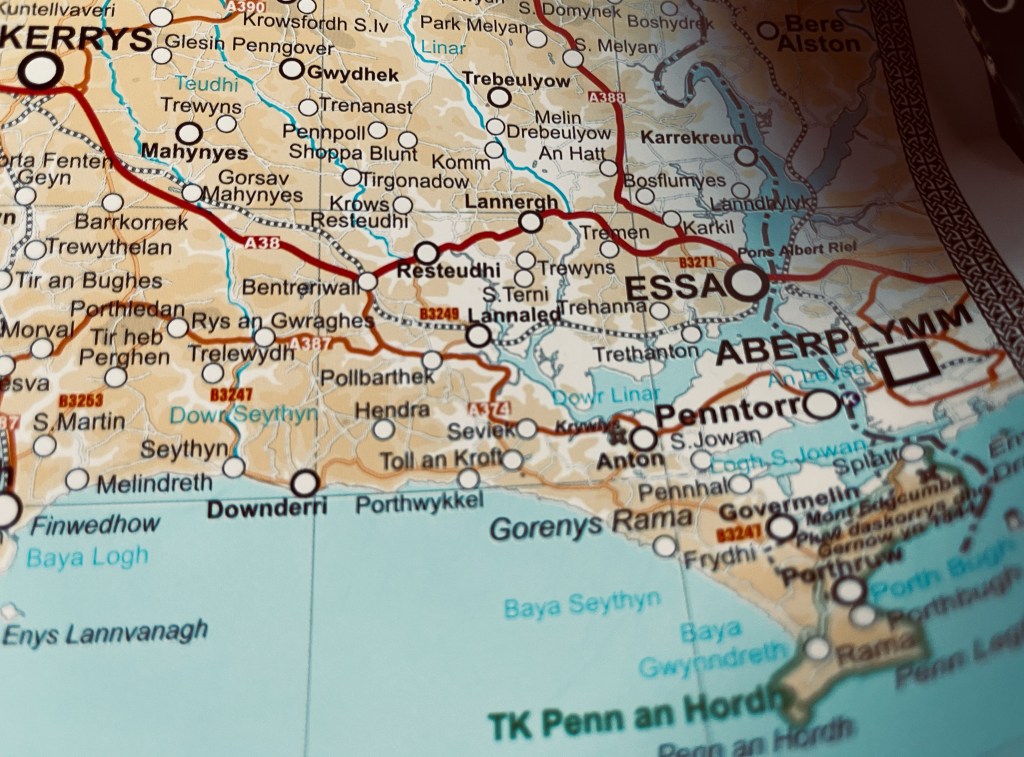
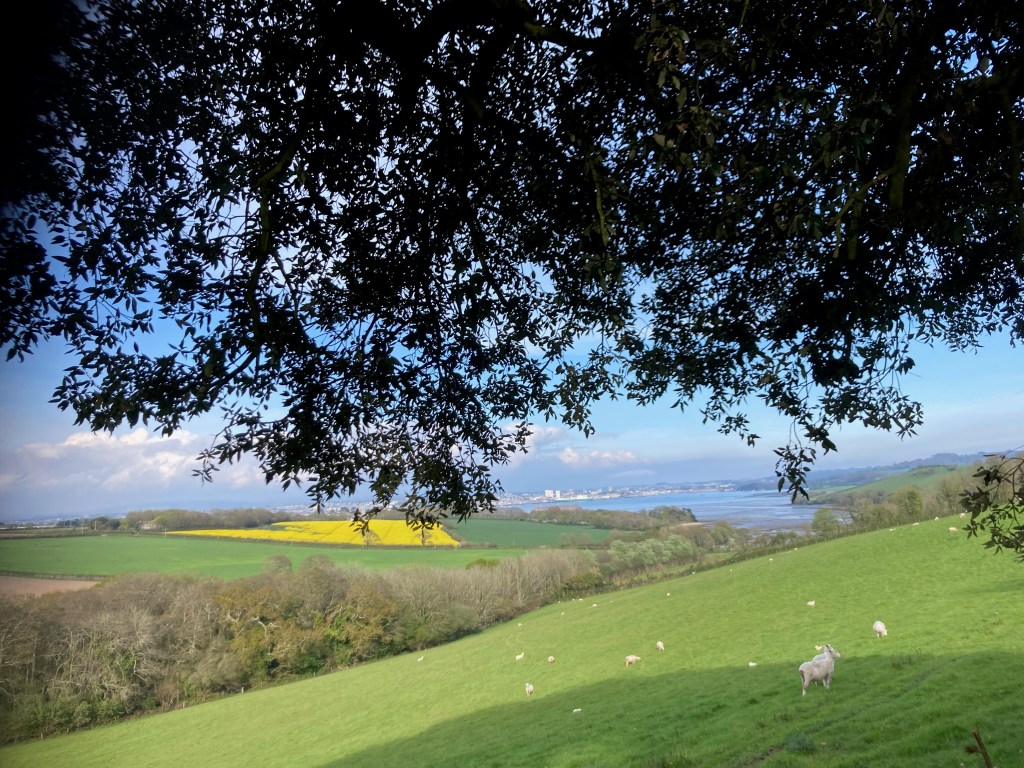
Dyworth an Mappa Kernewek gans Paul Kavanagh hag an Akademi Kernewek – from the Kernewek Map by Paul Kavanagh and the Akademi Kernewek
Dydh da.
Eyth mis a dhysk Kernewek yw passys lemmyn.
Eight months of learning Cornish have now passed.
This month has felt quieter linguistically than some of the earlier stages of the project. There have been fewer dramatic grammatical breakthroughs and less of the feeling that every lesson is introducing something entirely new. Instead, the language seems to have entered a period of consolidation.
That might sound less exciting, but I am increasingly convinced that it represents progress of a different kind.
Grammar into the Background
Earlier in the project, grammatical structures often dominated my attention. I was constantly trying to work out how particular constructions functioned or how Cornish differed from Welsh and English.
This month, grammar has increasingly moved into the background.
Most of the structures appearing in the Say Something lessons now feel familiar enough that I can usually concentrate on producing the language rather than consciously analysing it. The remaining uncertainties tend to be quite localised: how best to express a particular relative construction, for example, or which form of a verb fits a specific meaning.
That change is significant. The language no longer feels like an unstable grammatical system that I am trying to hold together. Increasingly, it feels like something I can move around within.
The main difficulty now is often vocabulary retrieval.
Words that I know I have encountered before sometimes hover just outside active recall. During this month I repeatedly rediscovered words such as treweythyow (“sometimes”), lowr (“enough”), tyller (“place”), sowndya (“to sound”) and yntendya (“to intend”).
Rather than seeing this as forgetting, I have begun to regard it as part of the process of moving vocabulary from passive recognition into active use.
Choosing My Own Cornish
Something else has changed in the way I think about vocabulary.
Earlier in the project, I was often simply trying to remember whichever word had appeared in the course. Now, when several synonyms are available, I increasingly find myself choosing which one I actually want to use.
For “challenge”, for example, I found myself preferring er to chanllenj, partly because of its relationship with Welsh her. Similar choices arose with forms such as kudyn and problem, or ambos and promys.
This feels like a small but meaningful shift.
I am no longer simply asking, “What is the Cornish word for this?”
I am beginning to ask, “Which Cornish word do I want to make part of my own active vocabulary?”
That perhaps marks another step towards developing a personal relationship with the language.
Welsh: Still Present, but Less Dominant
Welsh remains an important part of the learning process.
Cognates such as diank and Welsh dianc (escape), tyli and talu (pay), or gwari and chwarae (play) still provide useful anchors. Spending the summer in Swansea also brought some of these connections into sharper focus. The Cornish tyller (place), for example, reminded me of South Welsh tyle (hill), a word I had only recently become familiar with.
But Welsh now seems slightly less dominant than it did earlier in the project.
At the beginning, I often felt that I was approaching Cornish through Welsh. Now Cornish itself is beginning to provide the reference system. Words and structures reappear across courses, books, messages and conversations, and that repetition makes the language feel increasingly coherent in its own right.
The relationship between the two languages remains useful, but Cornish is gradually becoming less dependent on Welsh as a scaffold.
Speaking First, Grammar Later
One of the most satisfying developments this month has been seeing how my different learning resources complement each other.
Say Something continues to provide rapid spoken practice and keeps familiar structures active. Bore Brav, by contrast, gives me an opportunity to slow down and examine how those structures actually work.
This order suits me extremely well.
Rather than learning grammatical rules first and then attempting to apply them, I have usually encountered and used patterns repeatedly before later reading an explanation. When I read about the different functions of gul, forms of bos, or distinctions such as eus and usi, the grammar attaches itself to something I already recognise.
It feels less like learning a rule and more like finally understanding something I have already been doing.
Returning to the original Say Something in Cornish course after completing the newer Level 3 material reinforced this impression. Without the additional cognitive effort of translating from Welsh into Cornish, the lessons felt considerably easier than they had the first time around. I could concentrate instead on details such as mutation patterns and alternative constructions.
That was encouraging evidence that something has genuinely changed.
When the Language Starts to Explain Itself
I also noticed a small but interesting change when reading authentic Cornish.
Messages that would once have sent me immediately to a dictionary are becoming more transparent.
A reference to a poetry workshop, for example, could be partly unpacked simply by recognising the components ober (“work”), shoppa (“shop”) and prydydhi (“poetry”).
These are modest moments, but they matter. They suggest that I am beginning to develop an internal sense of how Cornish words are constructed rather than relying entirely on translation.
The language is starting, occasionally, to explain itself.
From Participation to Creation
The most important development this month, however, has probably happened outside the lessons.
On 19 August I created Kernewek yn Karesk, a Facebook group for people in and around Exeter who are interested in learning and speaking Cornish.
At first this was simply a practical experiment. I wanted to see whether there were other learners locally and whether a small conversation group might eventually be possible.
But the idea has gradually become more significant.
For much of this project I have been looking for opportunities to use Cornish: online sessions, events, conversation groups and contact with more experienced speakers.
Now I find myself asking a different question:
What if some of those opportunities need to be created?
If there are learners around Exeter, perhaps the problem is not that nobody wants to speak Cornish, but that there is nowhere obvious for them to meet.
In that sense, Kernewek yn Karesk has become more than a Facebook page. It is a small experiment in creating a space where Cornish might be spoken outside Cornwall itself.
https://www.facebook.com/groups/2128020728153055
Speaking with Other Learners
A visit to a Cornish-speaking group in Plymouth brought this question into sharper focus.
The experience produced mixed feelings.
Speaking with more proficient learners made me very aware of how much distance remains between my own Cornish and genuinely fluent speech. Welsh occasionally slipped into my answers, and there were moments when I felt less confident than I had during structured practice.
At the same time, I felt welcomed.
That mattered.
We also discussed the history of Cornish orthographies, a subject that has appeared repeatedly during the project. What struck me was the sense among experienced speakers that many of those disputes now belong largely to the past.
That reinforced something I have increasingly felt myself: spelling matters, but communication matters more.
When people are actually speaking Cornish together, differences in orthography suddenly seem much less important than the fact that the language is being used.
Cornish as Communication
There were other, much smaller moments of communication during the month.
I exchanged messages in Cornish with another learner in Japan. I passed on learning resources after hearing Welsh broadcaster Tudur Owen express an interest in learning Cornish. I continued reading and interacting with messages from Kowethas an Yeth Kernewek.
None of these exchanges involved especially sophisticated language.
But that was not really the point.
Cornish is increasingly becoming a means of communication rather than simply the object of the project.
That feels important.
Creativity and Ownership
I have also been thinking more about writing and singing in Cornish.
Earlier in the project I began experimenting with a Cornish song, and during this month I found myself considering further possibilities.
Creative use seems like another natural stage in the process.
Producing a grammatically correct sentence is one thing. Using Cornish to express something personal is another.
The more I think about it, the more creativity seems closely connected to ownership of the language. At some stage, a language has to become something you can play with, reshape and use for your own purposes.
Eight Months In
Reaching the eight-month point has prompted a different kind of reflection.
The excitement of the early months has inevitably faded slightly. Progress feels steadier and less dramatic. There are fewer moments when a completely new structure suddenly opens up.
My motivation is therefore not quite the same as it was in January.
But something else has taken its place.
The research project itself has become part of the motivation.
Keeping the journal, reflecting on the process and watching the project gradually develop now give me a reason to continue that goes beyond simply improving my Cornish.
Looking back, I am genuinely unsure whether I would have maintained the same consistency without the autoethnographic element.
The research is no longer simply documenting the learning.
It is helping to sustain it.
Looking Ahead
With four months of the data-collection phase remaining, the next stage seems increasingly clear.
I probably do not need another large body of grammar.
Instead, I need to speak more. I need to keep reading, and I need to keep writing.
And, perhaps most importantly, I need to continue finding or creating situations in which Cornish can actually be used.
At the beginning of this project, the central question was largely:
How can I learn Cornish?
Eight months later, another question is becoming equally important:
Who will I speak it with?
And perhaps the answer, at least partly, is that rather than waiting for a speech community to appear around me, I may have to help build one.
Meur ras!
Trebanessa!
Month 8 Vocabulary
Here are some words and expressions that stood out this month:
treweythyow — sometimes
lowr — enough
tyller — place
er — challenge
kudyn — problem
ambos — promise
diank — escape
tyli — pay
gwari — play
mos yn-mes — go out
Ny wonn — I don’t know
prydydhi — poetry
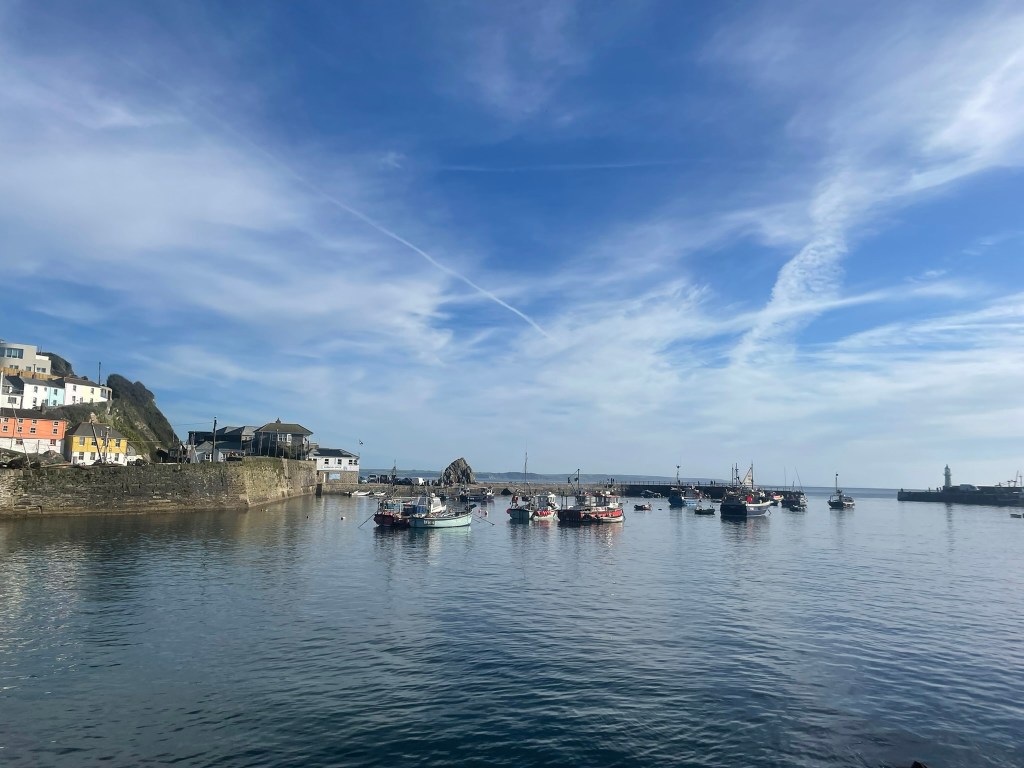
Dyworth Mappa an Pow Gorlewin – From the Dunlop Map of the West Country
Research Note – Month 8
(11 August – 10 September 2026)
Learning stage
This month appears to represent a consolidation phase. Grammatical structures are increasingly stable, while vocabulary retrieval, synonym choice, and active lexical selection have become more prominent concerns.
Key linguistic developments
- Shift from learning new grammar toward maintaining and refining existing structures
- Greater attention to vocabulary retrieval and the movement from passive to active knowledge
- Increasingly conscious selection between alternative lexical forms
- Growing ability to infer meaning from word formation and context rather than relying immediately on dictionaries
Cross-linguistic interaction
- Welsh remains an important scaffold through cognates and structural comparison
- Cornish is becoming more autonomous as an internal reference system
- Transfer from Welsh is still visible in spontaneous speech, particularly during less controlled interaction
Learning strategies
- SSIW supports fluency, retrieval, and automaticity
- Bore Brav supports slower grammatical analysis and retrospective understanding
- Revisiting earlier SSIK material provides evidence of increased procedural fluency and confidence
- Workarounds remain an important strategy when precise grammatical forms are uncertain
Community and participation
- Movement from seeking existing opportunities to actively creating them
- Establishment of Kernewek yn Karesk marks an early form of local language-community building
- Interaction with speakers and learners in Plymouth, Japan, and online channels reinforces Cornish as a communicative medium rather than only a study object
Affective and motivational development
- Early-stage novelty has reduced, and progress feels steadier and less dramatic
- Confidence can fluctuate after contact with more proficient speakers
- The research project itself has become an important source of motivation and continuity
Emerging research themes
- Consolidation and proceduralisation in later-stage beginner learning
- Lexical choice as part of developing an individual speaker repertoire
- The relationship between structured courses and authentic language use
- Community creation as part of minority-language acquisition
- Research activity as a factor in sustaining learner motivation
Provisional interpretation
Month 8 marks a shift from acquisition toward ownership and participation. I am no longer focused primarily on accumulating grammar and vocabulary, but increasingly on selecting a personal repertoire, interpreting authentic language, sustaining regular use, and helping create opportunities for Cornish to be spoken.