Learning Kernewek: Month 9 – Making Room for Conversation

A Language Project in Practice – Ragdres Yeth yn Praktis

11 September to 11 October 2026

Dydh da.

Nine months into this project, Cornish is beginning to occupy a different place in my life.

Whilst, the daily practice continues. I still forget words, repeat lessons and hesitate over grammatical forms. However, this month I also put posters up around Exeter, joined an online conversation group and sat in a café speaking Cornish with someone who had responded to the ad.

These developments have made the relationship between learning and speaking feel a little more real. I am now creating occasions where I want to speak Kernewek live, in the flesh as it were.

Keeping the Language Available

Much of my formal practice this month involved consolidation.

Working through the old Say Something in Welsh Level 3 course while responding in Cornish gave me repeated practice with short verb forms. Some came readily; others required more thought. When a short form was unavailable, I could usually use a longer construction and keep going. And this flexibility seems to be useful.

Vocabulary remains less dependable. Revisiting my earlier blog posts reminded me of words I had once used quite confidently but could no longer retrieve immediately. Towards the end of this month, a revision lesson produced much the same experience: the grammatical structures were reasonably secure, but individual words had slipped out of reach.

The blog is therefore becoming a resource for learning as well as a record of it. There is language in these posts that I need to recycle.

Returning to the Beginning

Towards the end of September, I returned to the original Say Something in Cornish course.

Part of the reason was nervousness. People were responding enthusiastically to Kernewek yn Karesk, and some were writing to me in very good Cornish. I was pleased, but also suddenly conscious that I was inviting people to speak a language I am still learning myself.

Going back to earlier lessons seemed sensible.

The vocabulary was mostly familiar, which gave me space to notice grammatical patterns I had not been using quite accurately or confidently. More surprisingly, I began understanding familiar material in new ways.

The connection between omlowenhe, “to enjoy oneself”, and lowen, “happy” or “joyful”, suddenly became clear. Other constructions began to make more sense through what I had learned about the verbs behind them.

I was returning with several months of additional experience from reading, listening and other courses. The lesson was familiar, but my understanding had changed.

Welsh as Help and Habit

Welsh continues to provide useful connections.

Related words and familiar endings often make Cornish easier to remember. Recognising parts of a word also helps. Vocabulary becomes more manageable when I can see how it is put together.

But Welsh influences what I produce as well as what I understand.

During our second Exeter meeting, Pol ( pseudonym) corrected my pronunciation of du, “black”. I had been carrying the Welsh vowel into Cornish. It was a small correction, but a useful reminder that something can feel entirely familiar and still need attention.

Listening more widely has helped here too. I listened to all twelve episodes of the BBC Learn Cornish podcast and followed the lyrics of Gwenno’s songs. Differences between speakers increasingly interest me, and more words and structures are becoming recognisable when I hear them.

Cornish is gradually acquiring a range of voices in my mind.

An Unpredictable Conversation

On 28 September, I joined an online Cornish conversation group for around an hour and a half.

The other participants were proficient speakers, and I was very aware of the difference between their spoken Cornish and mine. I could contribute to some extent, but at one point I could not understand a question and we briefly switched to English.

I came away with mixed feelings.

I had enjoyed listening to Cornish being used naturally and had managed to make myself understood. Yet my speaking felt less comfortable than it often does during a lesson.

The experience reminded me of my early attempts to speak Welsh after working through SSIW. In a course, I know the context and can anticipate the sort of response required. In conversation, somebody can ask something I have not prepared for at all.

That changes the task considerably.

I have to understand, decide what I want to say and retrieve the language while the conversation continues around me. More lessons may help, but I also need experience of doing precisely that.

I intend to carry on.

Kernewek in Exeter
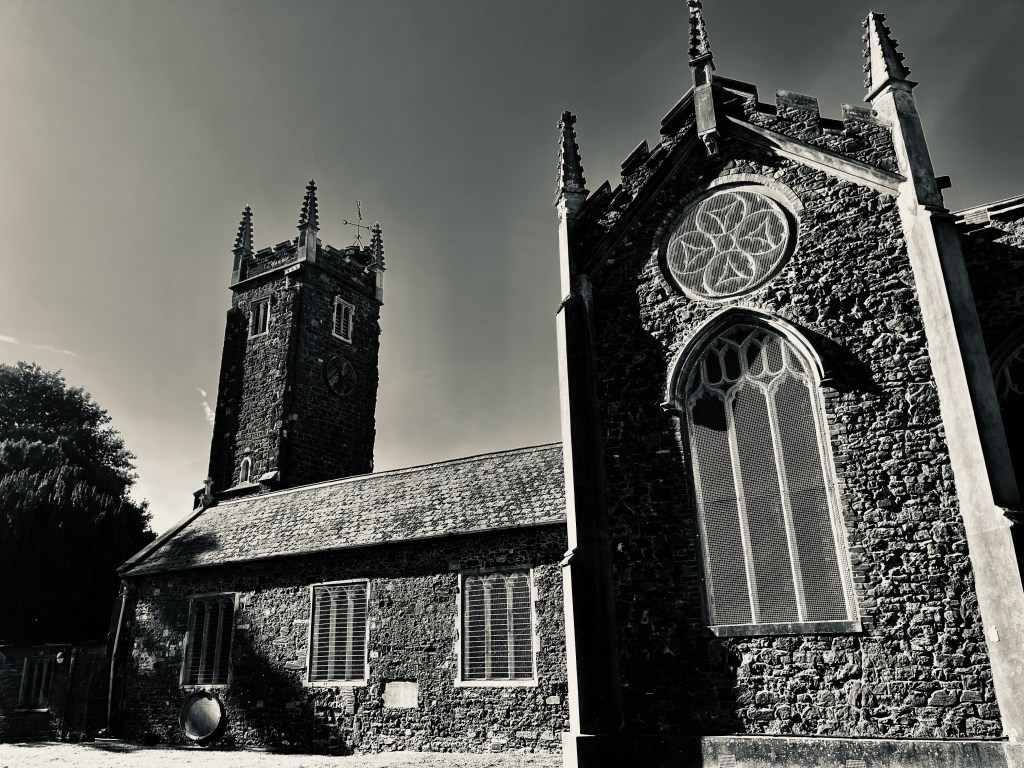
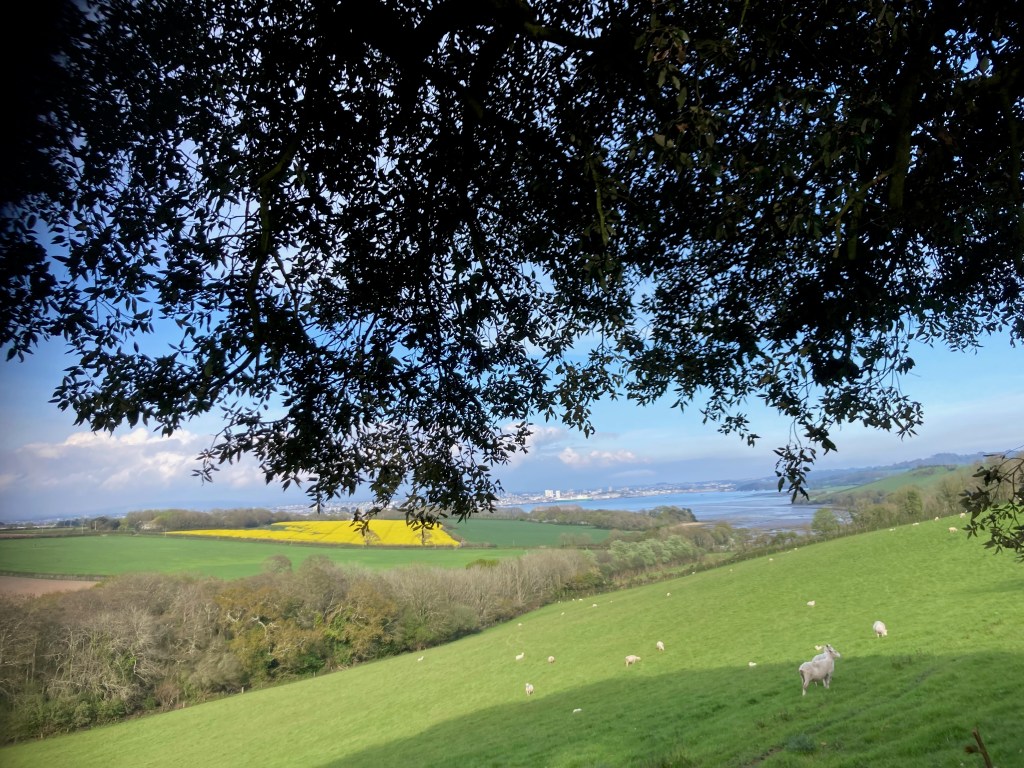
Eglos Sen Tommas, Karesk – St Thomas Church, Exeter. Photo – author’s own

Kernewek yn Karesk became a practical reality this month.

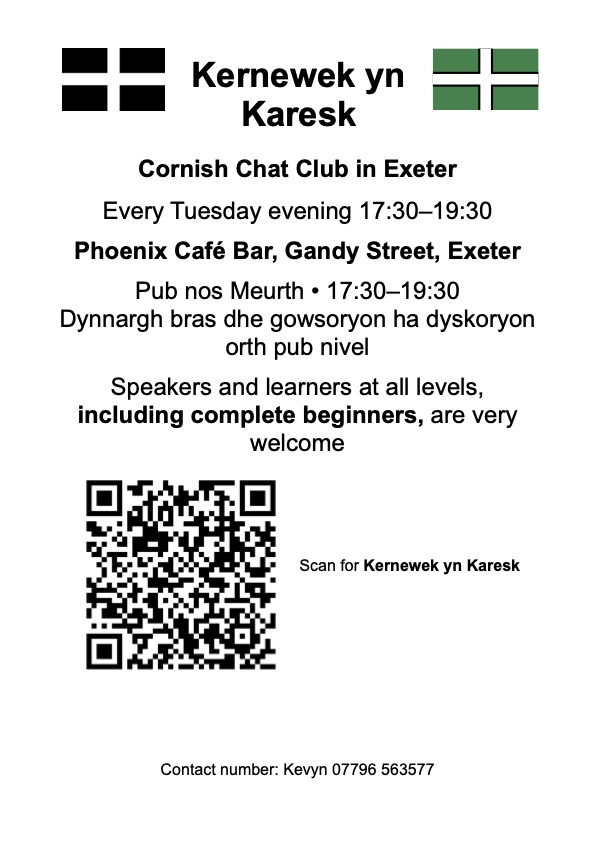
I worked on the poster, incorporated the Cornish and Devon flags and made clear that complete beginners would be welcome. Putting posters up in supermarkets was a modest step, but it meant the invitation had finally left my computer.

The first meeting took place on 29 September.

There were two of us. We spoke some Cornish, although much of the conversation was in English. Pol had a good range of vocabulary, but also described finding spoken use difficult.

That made the purpose of the group feel clearer. We both needed somewhere to practise.

At the following meeting, we spoke considerably more Cornish.

However, the group is still small, and establishing something regular will take time. Nevertheless, other people have expressed interest, and there is now an actual place and occasion for Cornish conversation in Exeter.

Earlier in the month, I walked around the city looking for connections with Cornwall and its wider Brythonic past. That helped me think about the local setting for the group. Now I am beginning to discover who might want to use Cornish here today.

Funnily enough, Pol turned out to be a historian. We discussed the Prayer Book Rebellion of 1549 and its connection with St Thomas Church, pictured above. Its vicar, Robert Welshe, a Cornishman, was hanged from the church tower following his involvement in the rebellion.

A Resource Taking Shape

I have also started developing a small learning app, Kernewek yn Praktis.

The idea grows out of the active recall practice I have been using throughout this project: see a prompt, try to say the Cornish aloud, reveal a model answer and assess how readily it came.

It is still at an early stage. I have been developing the first lesson, and Matt from the Aberplymm group has kindly agreed to help check its language.

That review matters. My experience as a learner can help shape the practice, but I also need knowledgeable speakers to scrutinise the content.

Alongside this, short AI-assisted practice sessions have helped me formulate language connected with my own life. Cornish transcription remains unreliable, so I have been typing responses. This provides useful writing and retrieval practice, although speaking with another person brings demands that these exercises do not reproduce.

Nine Months In

This month has made my remaining difficulties more visible.

Vocabulary still needs recycling. Some negative constructions need attention. Conversation can expose gaps that a familiar exercise allows me to overlook.

But I now have more opportunities to work with those difficulties.

There is an online group I can return to, a local meeting where I can try again and people willing to help with a resource for other learners.

I am still learning Cornish. I am also beginning to make room for it in everyday life.

Perhaps the most encouraging moment this month was simply sitting down with Pol for a second meeting and speaking more Cornish than we did the first time.

Meur ras!

Month 9 Vocabulary

Some words and expressions encountered or revisited this month:

  • kuntel: to collect
  • treghi: to cut
  • mos: to go
  • dos: to come
  • kavos: to have or get
  • lowen: happy or joyful
  • omlowenhe: to enjoy oneself
  • du: black
  • gweth: worse
  • gwethhe: to worsen
  • gortos: to wait
  • gortos rag: to wait for

Research Note – Month 9

11 September to 11 October 2026

Learning stage

Consolidation continues, with a growing emphasis on retrieving existing knowledge during interaction. Revisiting introductory material reveals both residual uncertainties and a deeper understanding of previously practised structures.

Linguistic development

Short verb forms are becoming more familiar, while alternative constructions help sustain production. Vocabulary retrieval remains variable. Word formation and cognates support recall, but Welsh influence can also persist in pronunciation.

Learning strategies

Repeated course practice, listening, retrospective grammatical understanding and personally relevant prompts increasingly complement one another. Earlier journal and blog entries offer material for recycling vocabulary.

Community participation

Joining an online conversation group and launching Kernewek yn Karesk create opportunities for spontaneous use. More Cornish was spoken at the second local meeting, suggesting that familiarity and repeated contact may help participation.

Affective development

Contact with proficient speakers and responsibility for organising a group can heighten awareness of limitations. Enjoyment, encouragement and the decision to participate again coexist with this uncertainty.

Emerging research themes

  • The relationship between course performance and spontaneous communication
  • Vocabulary availability under conversational pressure
  • Cross-linguistic support and interference
  • The learner’s developing role as a community organiser
  • Collaboration between learners and experienced speakers in resource creation

Provisional interpretation

Month 9 suggests that learning and participation are beginning to influence one another more directly. Interaction identifies practical needs, while revision and retrieval practice help prepare for further interaction. The local group and emerging app also extend the project into creating opportunities for other people to use Cornish.
Learning Kernewek: Month 8 – From Learning the Language to Creating Spaces for It

A Language Project in Practice – Ragdres Yeth yn Praktis

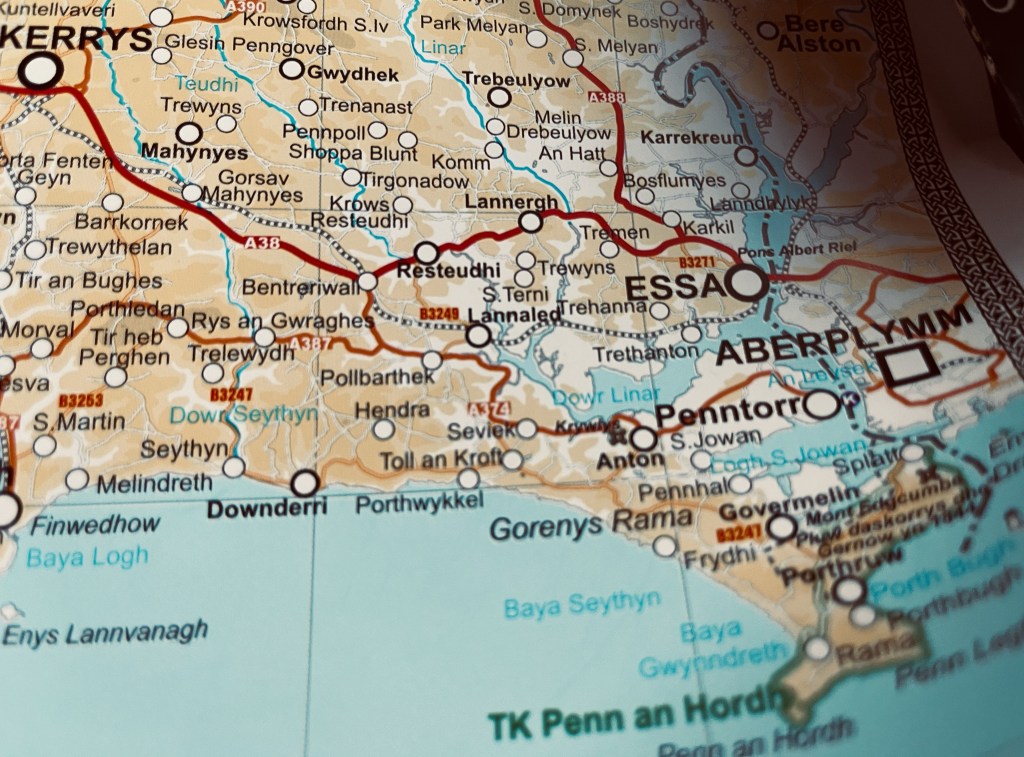
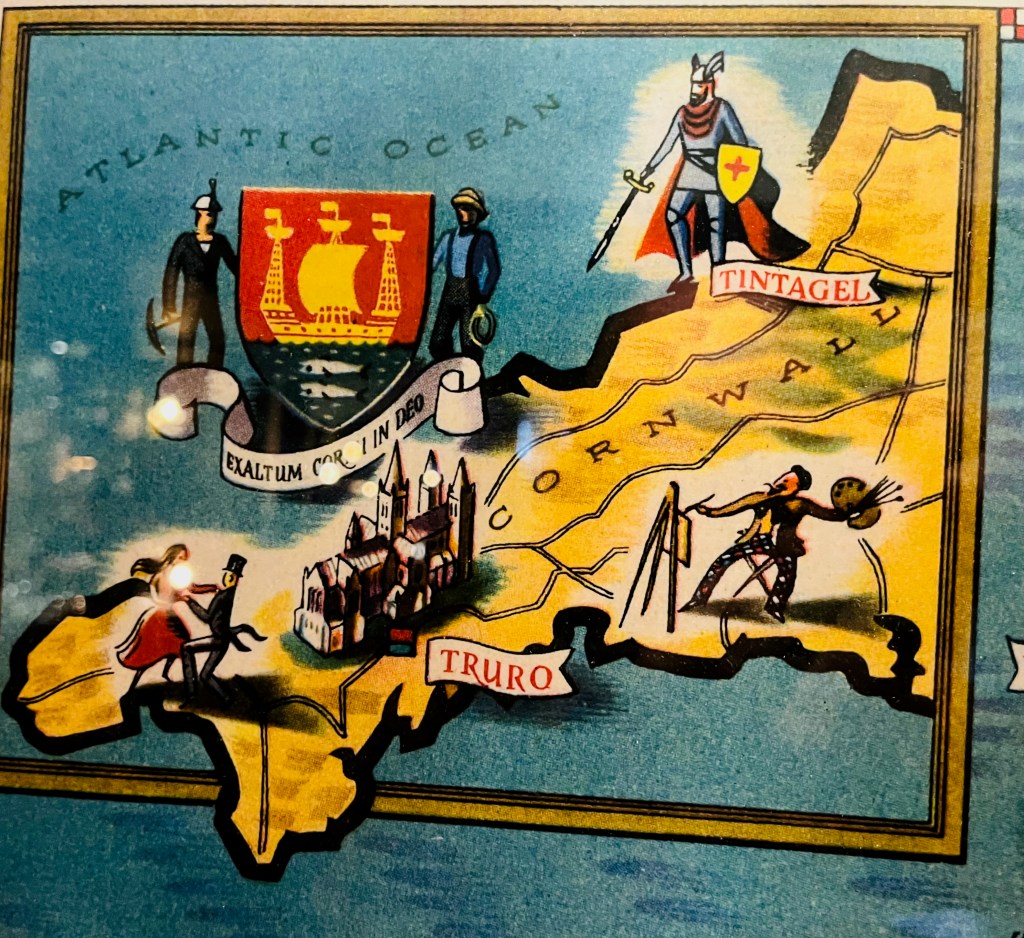
Dyworth an Mappa Kernewek gans Paul Kavanagh hag an Akademi Kernewek – from the Kernewek Map by Paul Kavanagh and the Akademi Kernewek

Dydh da.

Eyth mis a dhysk Kernewek yw passys lemmyn.

Eight months of learning Cornish have now passed.

This month has felt quieter linguistically than some of the earlier stages of the project. There have been fewer dramatic grammatical breakthroughs and less of the feeling that every lesson is introducing something entirely new. Instead, the language seems to have entered a period of consolidation.

That might sound less exciting, but I am increasingly convinced that it represents progress of a different kind.

Grammar into the Background

Earlier in the project, grammatical structures often dominated my attention. I was constantly trying to work out how particular constructions functioned or how Cornish differed from Welsh and English.

This month, grammar has increasingly moved into the background.

Most of the structures appearing in the Say Something lessons now feel familiar enough that I can usually concentrate on producing the language rather than consciously analysing it. The remaining uncertainties tend to be quite localised: how best to express a particular relative construction, for example, or which form of a verb fits a specific meaning.

That change is significant. The language no longer feels like an unstable grammatical system that I am trying to hold together. Increasingly, it feels like something I can move around within.

The main difficulty now is often vocabulary retrieval.

Words that I know I have encountered before sometimes hover just outside active recall. During this month I repeatedly rediscovered words such as treweythyow (“sometimes”), lowr (“enough”), tyller (“place”), sowndya (“to sound”) and yntendya (“to intend”).

Rather than seeing this as forgetting, I have begun to regard it as part of the process of moving vocabulary from passive recognition into active use.

Choosing My Own Cornish

Something else has changed in the way I think about vocabulary.

Earlier in the project, I was often simply trying to remember whichever word had appeared in the course. Now, when several synonyms are available, I increasingly find myself choosing which one I actually want to use.

For “challenge”, for example, I found myself preferring er to chanllenj, partly because of its relationship with Welsh her. Similar choices arose with forms such as kudyn and problem, or ambos and promys.

This feels like a small but meaningful shift.

I am no longer simply asking, “What is the Cornish word for this?”

I am beginning to ask, “Which Cornish word do I want to make part of my own active vocabulary?”

That perhaps marks another step towards developing a personal relationship with the language.

Welsh: Still Present, but Less Dominant

Welsh remains an important part of the learning process.

Cognates such as diank and Welsh dianc (escape), tyli and talu (pay), or gwari and chwarae (play) still provide useful anchors. Spending the summer in Swansea also brought some of these connections into sharper focus. The Cornish tyller (place), for example, reminded me of South Welsh tyle (hill), a word I had only recently become familiar with.

But Welsh now seems slightly less dominant than it did earlier in the project.

At the beginning, I often felt that I was approaching Cornish through Welsh. Now Cornish itself is beginning to provide the reference system. Words and structures reappear across courses, books, messages and conversations, and that repetition makes the language feel increasingly coherent in its own right.

The relationship between the two languages remains useful, but Cornish is gradually becoming less dependent on Welsh as a scaffold.

Speaking First, Grammar Later

One of the most satisfying developments this month has been seeing how my different learning resources complement each other.

Say Something continues to provide rapid spoken practice and keeps familiar structures active. Bore Brav, by contrast, gives me an opportunity to slow down and examine how those structures actually work.

This order suits me extremely well.

Rather than learning grammatical rules first and then attempting to apply them, I have usually encountered and used patterns repeatedly before later reading an explanation. When I read about the different functions of gul, forms of bos, or distinctions such as eus and usi, the grammar attaches itself to something I already recognise.

It feels less like learning a rule and more like finally understanding something I have already been doing.

Returning to the original Say Something in Cornish course after completing the newer Level 3 material reinforced this impression. Without the additional cognitive effort of translating from Welsh into Cornish, the lessons felt considerably easier than they had the first time around. I could concentrate instead on details such as mutation patterns and alternative constructions.

That was encouraging evidence that something has genuinely changed.

When the Language Starts to Explain Itself

I also noticed a small but interesting change when reading authentic Cornish.

Messages that would once have sent me immediately to a dictionary are becoming more transparent.

A reference to a poetry workshop, for example, could be partly unpacked simply by recognising the components ober (“work”), shoppa (“shop”) and prydydhi (“poetry”).

These are modest moments, but they matter. They suggest that I am beginning to develop an internal sense of how Cornish words are constructed rather than relying entirely on translation.

The language is starting, occasionally, to explain itself.

From Participation to Creation

The most important development this month, however, has probably happened outside the lessons.

On 19 August I created Kernewek yn Karesk, a Facebook group for people in and around Exeter who are interested in learning and speaking Cornish.

At first this was simply a practical experiment. I wanted to see whether there were other learners locally and whether a small conversation group might eventually be possible.

But the idea has gradually become more significant.

For much of this project I have been looking for opportunities to use Cornish: online sessions, events, conversation groups and contact with more experienced speakers.

Now I find myself asking a different question:

What if some of those opportunities need to be created?

If there are learners around Exeter, perhaps the problem is not that nobody wants to speak Cornish, but that there is nowhere obvious for them to meet.

In that sense, Kernewek yn Karesk has become more than a Facebook page. It is a small experiment in creating a space where Cornish might be spoken outside Cornwall itself.

https://www.facebook.com/groups/2128020728153055

Speaking with Other Learners

A visit to a Cornish-speaking group in Plymouth brought this question into sharper focus.

The experience produced mixed feelings.

Speaking with more proficient learners made me very aware of how much distance remains between my own Cornish and genuinely fluent speech. Welsh occasionally slipped into my answers, and there were moments when I felt less confident than I had during structured practice.

At the same time, I felt welcomed.

That mattered.

We also discussed the history of Cornish orthographies, a subject that has appeared repeatedly during the project. What struck me was the sense among experienced speakers that many of those disputes now belong largely to the past.

That reinforced something I have increasingly felt myself: spelling matters, but communication matters more.

When people are actually speaking Cornish together, differences in orthography suddenly seem much less important than the fact that the language is being used.

Cornish as Communication

There were other, much smaller moments of communication during the month.

I exchanged messages in Cornish with another learner in Japan. I passed on learning resources after hearing Welsh broadcaster Tudur Owen express an interest in learning Cornish. I continued reading and interacting with messages from Kowethas an Yeth Kernewek.

None of these exchanges involved especially sophisticated language.

But that was not really the point.

Cornish is increasingly becoming a means of communication rather than simply the object of the project.

That feels important.

Creativity and Ownership

I have also been thinking more about writing and singing in Cornish.

Earlier in the project I began experimenting with a Cornish song, and during this month I found myself considering further possibilities.

Creative use seems like another natural stage in the process.

Producing a grammatically correct sentence is one thing. Using Cornish to express something personal is another.

The more I think about it, the more creativity seems closely connected to ownership of the language. At some stage, a language has to become something you can play with, reshape and use for your own purposes.

Eight Months In

Reaching the eight-month point has prompted a different kind of reflection.

The excitement of the early months has inevitably faded slightly. Progress feels steadier and less dramatic. There are fewer moments when a completely new structure suddenly opens up.

My motivation is therefore not quite the same as it was in January.

But something else has taken its place.

The research project itself has become part of the motivation.

Keeping the journal, reflecting on the process and watching the project gradually develop now give me a reason to continue that goes beyond simply improving my Cornish.

Looking back, I am genuinely unsure whether I would have maintained the same consistency without the autoethnographic element.

The research is no longer simply documenting the learning.

It is helping to sustain it.

Looking Ahead

With four months of the data-collection phase remaining, the next stage seems increasingly clear.

I probably do not need another large body of grammar.

Instead, I need to speak more. I need to keep reading, and I need to keep writing.

And, perhaps most importantly, I need to continue finding or creating situations in which Cornish can actually be used.

At the beginning of this project, the central question was largely:

How can I learn Cornish?

Eight months later, another question is becoming equally important:

Who will I speak it with?

And perhaps the answer, at least partly, is that rather than waiting for a speech community to appear around me, I may have to help build one.

Meur ras!

Trebanessa!

Month 8 Vocabulary

Here are some words and expressions that stood out this month:

treweythyow — sometimes
lowr — enough
tyller — place
er — challenge
kudyn — problem
ambos — promise
diank — escape
tyli — pay
gwari — play
mos yn-mes — go out
Ny wonn — I don’t know
prydydhi — poetry

Dyworth Mappa an Pow Gorlewin – From the Dunlop Map of the West Country

Research Note – Month 8

(11 August – 10 September 2026)

Learning stage
This month appears to represent a consolidation phase. Grammatical structures are increasingly stable, while vocabulary retrieval, synonym choice, and active lexical selection have become more prominent concerns.

Key linguistic developments

  • Shift from learning new grammar toward maintaining and refining existing structures
  • Greater attention to vocabulary retrieval and the movement from passive to active knowledge
  • Increasingly conscious selection between alternative lexical forms
  • Growing ability to infer meaning from word formation and context rather than relying immediately on dictionaries

Cross-linguistic interaction

  • Welsh remains an important scaffold through cognates and structural comparison
  • Cornish is becoming more autonomous as an internal reference system
  • Transfer from Welsh is still visible in spontaneous speech, particularly during less controlled interaction

Learning strategies

  • SSIW supports fluency, retrieval, and automaticity
  • Bore Brav supports slower grammatical analysis and retrospective understanding
  • Revisiting earlier SSIK material provides evidence of increased procedural fluency and confidence
  • Workarounds remain an important strategy when precise grammatical forms are uncertain

Community and participation

  • Movement from seeking existing opportunities to actively creating them
  • Establishment of Kernewek yn Karesk marks an early form of local language-community building
  • Interaction with speakers and learners in Plymouth, Japan, and online channels reinforces Cornish as a communicative medium rather than only a study object

Affective and motivational development

  • Early-stage novelty has reduced, and progress feels steadier and less dramatic
  • Confidence can fluctuate after contact with more proficient speakers
  • The research project itself has become an important source of motivation and continuity

Emerging research themes

  • Consolidation and proceduralisation in later-stage beginner learning
  • Lexical choice as part of developing an individual speaker repertoire
  • The relationship between structured courses and authentic language use
  • Community creation as part of minority-language acquisition
  • Research activity as a factor in sustaining learner motivation

Provisional interpretation
Month 8 marks a shift from acquisition toward ownership and participation. I am no longer focused primarily on accumulating grammar and vocabulary, but increasingly on selecting a personal repertoire, interpreting authentic language, sustaining regular use, and helping create opportunities for Cornish to be spoken.

Learning Kernewek – Month 6: From Practice to Participation


A Language Project in Practice – Ragdres Yeth yn Praktis

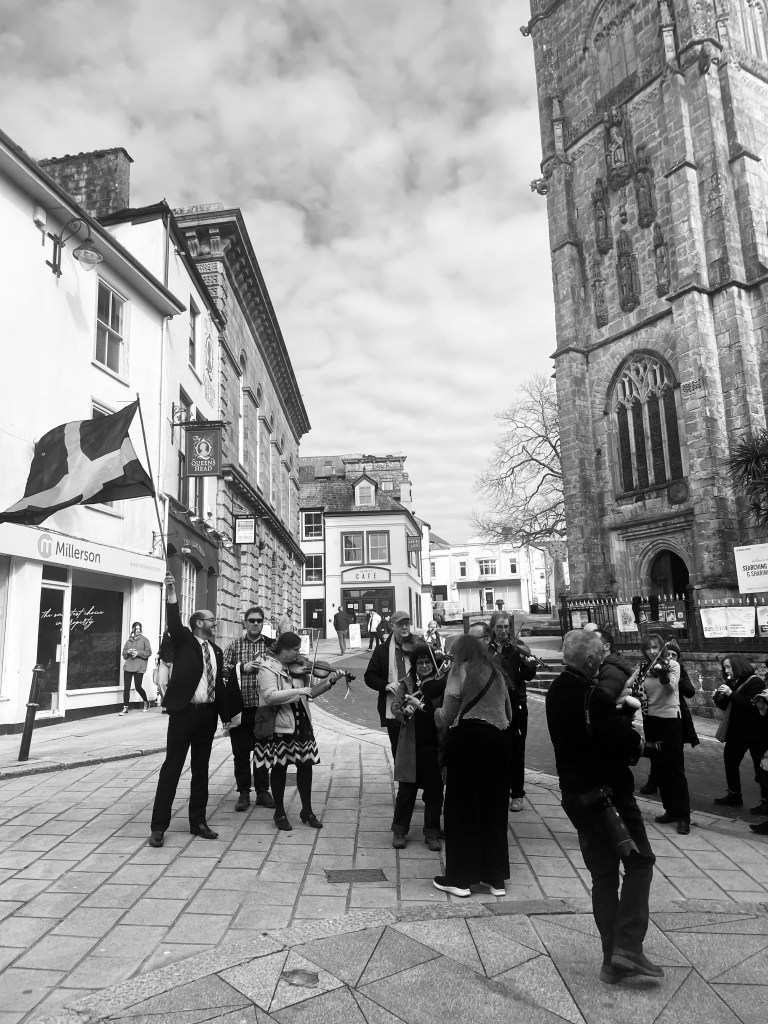
S. Jowan, Penntorr, Kernow – St John, Torpoint, Cornwall – photo: author’s own.

Dydh da.

Hwegh mis a dhysk Kernewek a veu passys lemmyn.

Six months of learning Cornish have now passed.

When I looked back over this month’s journal entries, one theme stood out above everything else. Although I continued to spend half an hour every day working through the Say Something in Welsh course while responding entirely in Cornish, the language increasingly escaped the boundaries of the lessons themselves. Rather than simply studying Cornish, I found myself using it in conversations, songs, books and online communities.

In many ways, this month felt like a transition. The first few months of the project were largely about building a foundation: learning vocabulary, developing basic grammatical patterns and gaining enough confidence to express simple ideas. This month, however, I began to feel that those individual pieces were starting to come together into something more coherent.

Consolidation is Progress

A surprising amount of this month’s learning consisted of revision. Much of the older SSIW course revisited grammatical patterns that I had already encountered. Earlier in the project I might have been disappointed by that, hoping for lots of new material. Instead, I found myself appreciating repetition.

The focus gradually shifted away from learning new words towards retrieving language more quickly and automatically. One observation I wrote in my journal particularly struck me. Earlier in the project I was often asking myself:

“How do I say this?”

Now I find myself thinking:

“Which construction should I use?”

That feels like quite a different stage of language learning. Instead of building sentences word by word, I am beginning to choose between alternative ways of expressing the same idea. It suggests that the language is gradually becoming a connected system rather than simply a collection of memorised phrases.

I also became increasingly aware that fluency and accuracy are not the same thing. There are still grammatical areas where I lack confidence, particularly conditionals, mutations and some inflected prepositions. Nevertheless, I no longer feel that these gaps prevent me from communicating. Increasingly I am happy to use the language I have, trusting that greater accuracy will come with continued exposure and use.

Using Cornish Beyond the Lessons

The most memorable event of the month was undoubtedly taking part in an online Cornish conversation group during Speak Cornish Week.

For around an hour I spoke with the event organiser [1] and two other fellow learners entirely in Cornish. It was probably the longest conversation I have ever had in the language.

The experience was exactly what real language use should be. Sometimes I understood almost everything. Sometimes I understood very little. Occasionally I slipped into Welsh without even noticing. Yet despite all of that, communication continued.

That unpredictability felt very different from the structured environment of the SSIW lessons. The lessons provide carefully controlled practice. Real conversations are much messier, requiring improvisation, approximation and resilience. They also showed me that I am much further along than I sometimes imagine. Although there were plenty of gaps in my knowledge, I was able to contribute, ask questions and follow much of the discussion.

Perhaps for the first time, I genuinely felt like a participant rather than simply a learner.

A Small Language Community

This month also reminded me just how small the Cornish language community is.

During the conversation group I discovered unexpected connections between people I already knew, including my former Cornish tutor and my Breton teacher. It really does seem to be a remarkably interconnected community.

At the same time, reading discussions on the Kowethas an Yeth WhatsApp groups exposed me to some of the concerns that naturally arise within a language revival movement. Contributors discussed the relatively small number of fluent speakers and debated the future direction of the language. As a learner, I occasionally found these conversations a little discouraging.

Yet I also realised that these debates exist precisely because people care deeply about Cornish. Every language community has disagreements. In a small revival movement they simply become more visible.

Cornish as a Living Language

One particularly encouraging experience came when I performed one of my own songs in Cornish with a group of friends in Porthcawl [2].

The response was warmly positive, and the song ‘An Mor ’ may now become part of a friend’s [3] musical project exploring the theme of endangered languages. That experience reminded me that Cornish is much more than a subject to study. It is also something that can be sung, shared and enjoyed.

In a similar way, I found myself reading more of the Cornish translation of Tintin. Alongside useful vocabulary, I encountered natural idiomatic expressions that are difficult to learn from formal courses alone. What pleased me most was how often I recognised grammatical patterns that I had learned months earlier.

That happened repeatedly throughout the month. A structure from SSIW would reappear in Tintin. A word from Gerlyver would appear in a WhatsApp conversation. Something I had read online would suddenly make sense during a lesson.

Rather than existing as separate learning resources, everything began reinforcing everything else.

Looking Ahead

Towards the end of the month I completed Old Course Level 2 and moved into Level 3.

That feels like another milestone. Level 3 introduces grammatical areas that I haven’t explored in as much depth before, particularly the relationship between the Welsh prompts and the Cornish forms I want to produce. I certainly don’t expect everything to be straightforward.

At the same time, I feel much more confident than I did even a month ago. My goal is no longer simply to finish another course. Instead, I want to continue building the confidence to attend conversation groups, participate in classes and use Cornish naturally whenever the opportunity arises.

Looking back over this month’s journals, perhaps the biggest change isn’t what I know but how I relate to the language itself.

Earlier in the project, Cornish often felt like something I was studying.

Increasingly, it feels like something I am beginning to use.

And that, I think, is one of the most satisfying milestones any language learner can reach.

Ha lemmyn yth esov ow dyski ny yn unnig gans lyvrow ha kursow, mes dre gows, ilow, lythereth ha’n gemeneth Kernewek hy honan.

And now I continue learning not only through books and courses, but through conversation, music, literature and the Cornish community itself.

Footnotes

Thanks to:

[1] Richard Simcock 

[2] Magic Marmalade Machine

[3] Perygl by Richard Thomas and Magic Marmalade Machine

Month 6 Vocabulary

  • apponsyans — examination
  • heb dout — without doubt
  • hwithra — search for
  • hwilas — look for
  • goslowes orth — listen to
  • gwitha war — look after
  • kendron — loan
  • darbari — prepare
  • fisky — hurry
  • difuno — wake
  • herdhya — push
  • kador — chair

Research Note – Month 6

  • Learning process
    • Retrieval becoming more important than acquisition
    • Increasing proceduralisation of grammatical knowledge
    • Growing integration of multiple learning resources
  • Communicative development
    • First extended spontaneous conversation
    • Increased willingness to approximate
    • Greater confidence in authentic interaction
  • Cross-linguistic processes
    • Welsh increasingly used for hypothesis generation rather than translation
    • Continued Brythonic pattern recognition
    • Greater sensitivity to where Welsh and Cornish diverge
  • Resource ecology
    • SSIW
    • Gerlyver
    • Tintin
    • WhatsApp
    • Conversation groups
    • Music
  • Emerging research themes
    • Integration of learning resources in adult language acquisition
    • Proceduralisation and automaticity
    • Community participation in revived-language learning
    • Multilingual scaffolding in Brythonic language acquisition
    • The development of communicative confidence under conditions of uncertainty

Learning Kernewek: Month 5 – From Course Learner to Community Participant

A Language Project in Practice – Ragdres Yeth yn Praktis

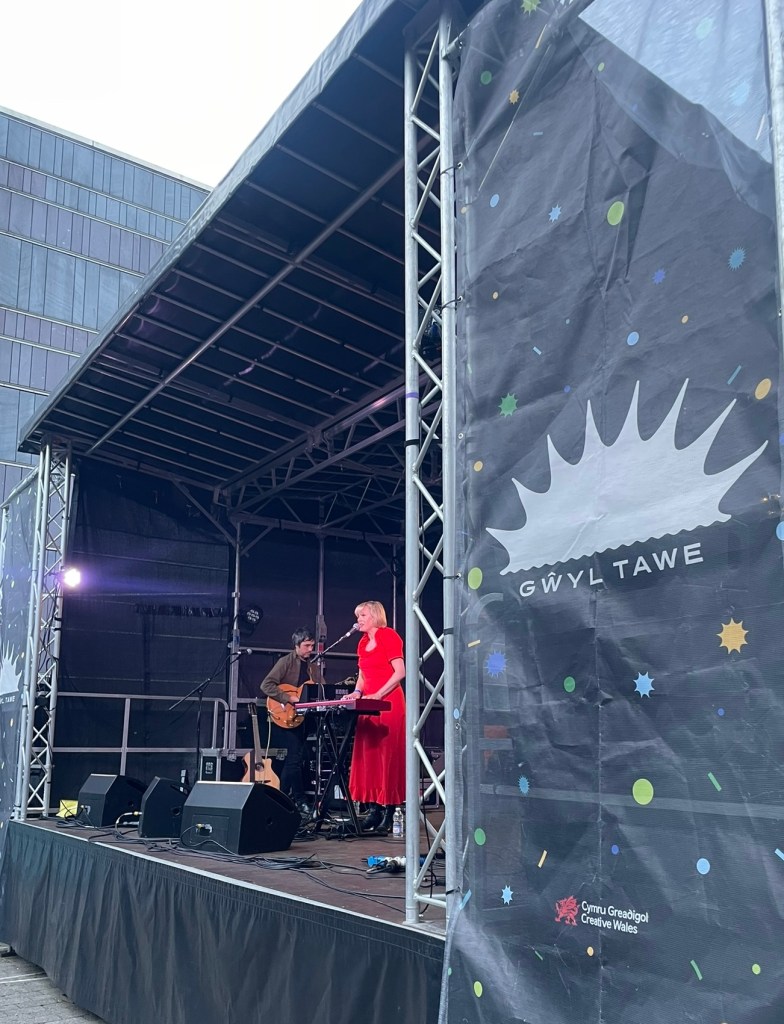
Gwenno, Gŵyl Tawe, Abertawe, 2026. Photo author’s own.


Dydh da.

Pymp mis a dhysk Kernewek a veu passys lemmyn.

An mis ma a omglewas differens aral. Mars o Mis 4 a-dro dhe dhyski pesya gans ansikkerder, Mis 5 a omglewas a-dro dhe dheves yn bywydh gwirion.

Good day.

Five months of learning Cornish have now passed.

This month felt different again. If Month 4 was about learning how to live with uncertainty, Month 5 was about seeing the language appear beyond learning itself.

For the first time, Cornish increasingly felt less like something I studied and more like something I encountered.

The language began appearing in books, songs, WhatsApp discussions, festivals, and everyday conversations.

At times, it felt as though the project was moving beyond language learning and into participation.


Finishing Level 3

One obvious milestone this month was completing SSIW Level 3.

Crossing that finish line felt significant, although perhaps not for the reason I expected.

Earlier stages of the project often felt dominated by grammar: learning sentence patterns, understanding mutations, handling conditionals, and gradually becoming comfortable with increasingly complex structures.

By the time I reached the end of Level 3, however, I realised that many of those structures no longer felt new.

They were not always easy, but they felt familiar.

That familiarity created a different kind of confidence.

The challenge was increasingly becoming not whether I could build sentences, but which words I wanted to put inside them.


From Grammar to Vocabulary

A noticeable shift this month was the growing importance of thematic vocabulary.

Returning to some of the older SSIW material introduced areas such as:

  • body parts
  • household objects
  • emotions
  • opinions
  • disagreement
  • personal history

Words increasingly arrived in clusters rather than isolation.

For example:

  • leuv (hand)
  • bregh (arm)
  • troos (foot)

or:

  • tybi (think)
  • ragweles (foresee)
  • dadhla (argue)

This felt different from earlier months.

Previously, vocabulary often seemed to serve grammar.

Now grammar increasingly served communication.

The language was becoming organised around real-world topics rather than abstract structures.


Welsh, Cornish, and Productive Guessing

Welsh continues to play a central role in my learning process.

The relationship, however, feels increasingly sophisticated.

Earlier in the project, Welsh mainly provided reassurance: familiar words, recognisable patterns, and useful shortcuts.

This month I found myself using Welsh more strategically.

Instead of asking:

“What is the Cornish translation?”

I increasingly found myself asking:

“What would a Brythonic language probably do here?”

That small change matters.

It encourages hypothesis-building rather than translation.

Sometimes those guesses were correct.

Sometimes they were not.

But increasingly they allowed communication to continue.

Perhaps more importantly, they helped Cornish feel like a system with its own internal logic rather than a collection of individual facts to memorise.


When Reading Starts to Work

One of the most encouraging moments this month came through reading.

I began working through Tintin: An Kanker ha’y Dhiwbaw Owrek and discovered something surprising.

Many of the structures felt immediately familiar.

Expressions that would have seemed completely inaccessible only a few months ago suddenly appeared understandable.

Of course, there were still unknown words.

There were still frequent dictionary checks.

But for the first time, the experience felt less like decoding and more like reading.

That distinction is important.

It suggested that input from multiple sources – SSIW lessons, community discussions, music, and reading – was beginning to converge into a single linguistic system.


From Learner to Participant

The strongest theme of the month was probably community.

Cornish increasingly appeared outside formal study.

Through WhatsApp groups, online discussions, festivals, reading, music, and social contacts, the language started to occupy a more natural place in everyday life.

Several experiences stood out.

Attending Gwenno’s performance at Gŵyl Tawe provided another opportunity to hear Cornish in a cultural setting.

Conversations surrounding the Prayer Book Rebellion led to deeper reflections about language suppression and revival.

Meanwhile, debates within Cornish-language spaces highlighted questions of identity, ownership, and belonging.

What struck me most was not necessarily the content of these discussions.

It was the fact that I could increasingly follow them.

A particularly satisfying milestone was realising that WhatsApp messages written by Cornish speakers no longer required painstaking word-by-word translation.

Meaning often emerged naturally.

That felt like a small but genuine breakthrough.


A Language or a Cultural Ecosystem?

Earlier in the project, Cornish often felt like a language course.

This month it increasingly felt like something much larger.

History appeared.

Politics appeared.

Music appeared.

Questions of identity appeared.

The language seemed less like a set of lessons and more like a cultural ecosystem.

This was especially noticeable in discussions about the Cornish revival, the Prayer Book Rebellion, and wider questions about language ownership and community.

Learning Cornish increasingly feels like entering a conversation that began long before I arrived.


Looking Ahead

At the end of Month 5, the project feels less focused on grammar and more focused on participation.

There are still plenty of linguistic challenges ahead.

Vocabulary remains vast.

Reading remains slow.

Authentic speech can still move far faster than I would like.

But the language is beginning to feel embedded within a wider network of people, places, books, music, and ideas.

Perhaps the most important development this month is that Cornish no longer feels confined to study sessions.

It is beginning to appear naturally in everyday life.

And that may be one of the clearest signs that a language is becoming real.


Ha lemmyn yth esov ow mos yn rag, ny yn unnig gans an yeth hy honan, mes gans an gemeneth a-dro dhedhi.

And now I move forward, not only with the language itself, but with the community around it.

Meur ras!

Trebanessa!


Month 5 Vocabulary

Some words and expressions that stood out this month:

  • leuv — hand
  • bregh — arm
  • troos — foot
  • tybi — think, suppose
  • ragweles — foresee
  • dadhla — argue
  • skerys — angry
  • yntanys — excited
  • isel — low, depressed
  • alhwedh — key
  • esedhva — living room
  • fortunys — fortunate
  • deskordya — disagree

Research Note – Month 5 (for those interested in the learning process)

Learning process

Transition from structured course progression toward broader linguistic participation.

Key linguistic developments

  • Completion of SSIW Level 3
  • Expansion of thematic vocabulary domains
  • Increased use of productive guessing strategies
  • Growing confidence in communicative approximation
  • Continued development of conditionals and imperfect forms

Cross-linguistic interaction

  • Welsh remains a major scaffold language
  • Increasingly strategic rather than automatic transfer
  • Growing awareness of lexical layers within Cornish
  • Continued development of a broader Brythonic linguistic repertoire

Learning behaviour

  • More selective use of repetition
  • Strategic prioritisation of useful vocabulary
  • Greater tolerance of ambiguity
  • Stronger trust in communicative momentum over perfection

Sociolinguistic dimension

  • Increased engagement with authentic Cornish materials
  • Growing participation in community discussions
  • Greater exposure to cultural and historical aspects of revival
  • Awareness of speaker scarcity as a continuing challenge

Emerging research themes

  • Participation versus observation in revived-language communities
  • Authentic input and comprehension development
  • Strategic multilingualism in Brythonic language learning
  • Identity formation through cultural participation
  • The transition from language learning to language community

Learning Kernewek: Month 4 – Complexity, Confidence, and Letting Go of Perfection

A Language Project in Practice – Ragdres Yeth yn Praktis

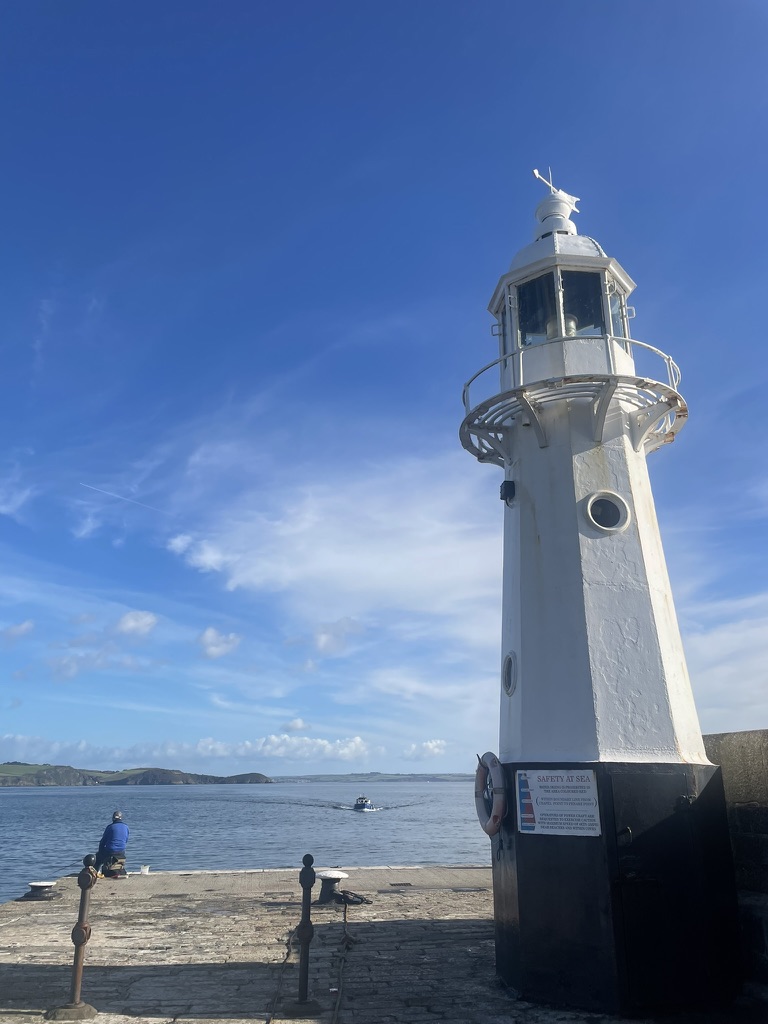
Lighthouse, Mevagissey / Golowji, Lannvorek, Kernew – photo author’s own.

Dydh da.

Peswar mis a dhysk Kernewek a veu passys lemmyn.

An mis ma a omglewas differens bras. Nyns o hemma yn unnig a-dro dhe dhyski lavarow nowydh, mes a-dro dhe dhyski fatel pesya gans ansikkerder.

Good day.

Four months of learning Cornish have now passed.

This month felt noticeably different. It was no longer only about learning new words, but about learning how to continue despite uncertainty.

Earlier months often felt like building: adding vocabulary, recognising patterns, constructing simple sentences. Month 4 felt more like stretching. The structures became longer, the clauses more tangled, and the language less stable.

At times, it felt as though the learning process itself was being tested.

When the Language Gets Harder

The clearest development this month has been the increase in structural complexity.

Lessons increasingly involved:

  • conditionals
  • linked clauses
  • past constructions
  • hypothetical situations

Sentences such as:

Mar pethen vy…
(If I were…)

or:

Ny wrug ev leverel dhymm pyth ev a vynnas
(He didn’t tell me what he wanted)

began to appear more regularly.

Unlike vocabulary learning, these structures are difficult because they require several things to happen simultaneously:

  • recalling grammar
  • organising clause order
  • managing tense
  • keeping the overall meaning in mind

At times, the process felt like walking a tightrope. I could often produce around 80% of a sentence while the remaining 20% hovered just beyond reach.

Interestingly, the difficulty did not usually come from encountering completely new material. More often, it came from trying to coordinate things I partly already knew.

This month made it very clear that language learning is not simply accumulation. Complexity creates its own kind of pressure.

Speaking Without Knowing Everything

One of the most important changes this month has been psychological rather than linguistic.

Earlier on, gaps in knowledge often felt like barriers. Now they increasingly feel like spaces to work around.

If I cannot remember an exact structure, I try to say something close enough:

  • rebuilding sentences from fragments
  • substituting simpler constructions
  • temporarily borrowing from Welsh
  • restructuring ideas in real time

What I jokingly called “Caveman Cornish” last month has started to become something more useful: functional approximation.

Rather than stopping communication, approximation keeps the language moving.

This has changed the way I think about fluency. Fluency no longer means producing perfect sentences. It increasingly means: keeping going, maintaining meaning, and surviving uncertainty without switching back into English.

The “80% rule” continues to matter here. As long as most of a structure is accessible, I move forward rather than waiting for total mastery. Paradoxically, this often seems to help the language settle more naturally over time.

Welsh Carrying Some of the Load

Welsh continues to play a central role in the learning process, but again its function has shifted slightly this month.

Earlier on, Welsh mainly acted as support: shared vocabulary, similar grammar, familiar sentence patterns. Now it feels more like a constantly active parallel system.

Sometimes the connections are obvious:

gweyth / gwaith
hireth / hiraeth
Dy’ Yow / Dydd Iau

At other times, the interaction is more complicated.

There were moments this month when I expected Cornish to behave like Welsh and it simply did not. For example, Welsh often uses English-derived vocabulary where Cornish preserves older Brythonic forms:

problem → kudyn

And sometimes when I was expecting a Welsh cognate, an English one appears:
offer → provyans / provya

At the same time, influence increasingly started moving in both directions.

One evening at our Welsh conversation group, rather embarrassingly, I completely forgot the Welsh word ceffyl (“horse”), despite having known it for years; since school even. Instead, the Cornish/Breton word margh came to mind first. That small moment felt surprisingly significant.

Cornish no longer seems to exist only as a learner project sitting beside Welsh. It is beginning to occupy space within the same mental linguistic system.

What is emerging feels less like “transfer” between separate languages and more like movement within a shared Brythonic linguistic environment.

Repetition, Rustiness, and Recovery

This month also disrupted the idea that progress should always feel linear.

After a short holiday and a break from Cornish practice, I returned feeling a little rusty. Familiar structures suddenly felt unstable, especially the conditionals.

For a while, this created genuine panic: had I forgotten more than I realised?

But something interesting happened.

After repeating lessons, reviewing old patterns, and revisiting earlier material, the language came back surprisingly quickly. In some cases, repetition actually produced stronger fluency than before.

Accidentally repeating one lesson led to a noticeable jump in confidence and automaticity. Structures that had previously felt fragile suddenly became much easier to retrieve.

This month has made me think differently about repetition.

Review no longer feels like “going backwards”. It feels developmental in its own right.

Some structures now feel deeply embedded: patterns from the very beginning of the course still reappear naturally during speech.

Others remain unstable, particularly:

  • conditionals
  • continuous past constructions
  • pronouns linked to prepositions

But overall, the recovery from rustiness felt reassuring. The language appears more resilient than I had assumed.

From Learning a Language to Entering a Community

Another important development this month has been increased participation in the social side of the language.

I began volunteering as a tester for a Cornish learning app, became more active in WhatsApp discussions, and signed up for another An Werin Warlinen online session.

Small things also started to shift psychologically.

Friends began sending me articles about the Cornish revival. I found myself reading more Cornish messages online without immediately having to translate them word by painful word. Discussions in the community increasingly felt accessible rather than distant.

There were also interesting overlaps between Welsh and Cornish spaces. A Welsh/Cornish speaker I know is going to appear on Welsh-language media (Radio Cymru) soon, discussing learning Cornish and the language’s revival. Also, conversations about Cornish emerged naturally inside Welsh-speaking contexts, such as the Welsh language chat group I attend here in Exeter (Clwb Clebran Caerwysg), and the online Welsh class I am taking with Cardiff University.

This reinforced something I have increasingly noticed throughout the project:
revived minority languages do not exist in isolation.

They exist socially, culturally, and emotionally, through networks of learners, speakers, supporters, and neighbouring languages.

Level 3 and a Different Kind of Confidence

This month also marked the completion of Level 2 and the beginning of Level 3 in the SSIW course.

Crossing into a new level felt important, though perhaps not in the way I expected.

Earlier in the project, new levels sometimes felt a little intimidating. This time, the transition felt more manageable. The lessons were still difficult in places, but the difficulty no longer felt threatening in the same way.

That may be the most important shift of all.

I am not necessarily becoming dramatically more accurate. But I am becoming more comfortable continuing despite imperfection.

The language increasingly feels less like something I need to solve before using and more like something I can participate in while still learning.

Looking Ahead

At the end of Month 4, the project feels both less stable and more secure.

Less stable because the language is becoming more complex:
more clauses, more variation, more ambiguity, and more interference between systems.

But more secure because I increasingly trust that communication can continue even when everything is not fully under control.

The most important development this month may simply be this:
learning how to keep speaking anyway.

Ha lemmyn yth esov ow mos yn rag gans nebes moy a gyfyans.

And now I move forward with a little more confidence.

Meur ras!

Trebanessa!

Month 4 Vocabulary

Some words and expressions that stood out this month:

mar pethen vy — if I were
kudyn — problem
provyans — offer
heb kost — free of charge
kyns — before
bys — until
gortheb — answer
krambla — to climb
gasa vy — let me
margh — horse / steed

Research Note – Month 4

(April–May 2026)

Learning stage
Month 4 appears to mark a shift from pattern consolidation towards structural expansion and strategic fluency. As sentences become longer and more complex, progress increasingly depends not on perfect recall but on the ability to continue communicating despite uncertainty.

Key linguistic developments

  • Greater exposure to conditionals, linked clauses and past constructions
  • Increasing use of multi-clause sentences under time pressure
  • Greater awareness of grammatical alternatives, lexical nuance and register variation
  • Recognition that complex production requires simultaneous control of tense, clause order, meaning and retrieval

Cross-linguistic interaction

  • Welsh continues to function as an important scaffold
  • Evidence of increasingly multidirectional influence between Welsh and Cornish
  • Growing awareness of interference as well as helpful transfer
  • Emergence of a more integrated Brythonic linguistic repertoire

Learning strategies

  • Stronger reliance on approximation, reconstruction and educated guessing
  • Greater willingness to leave minor gaps unresolved in order to maintain communicative flow
  • Continued use of repetition to improve automaticity
  • Increasing tolerance of partial recall and ambiguity during real-time production

Affective development

  • Confidence becomes less dependent on producing fully accurate sentences
  • Frustration with uncertainty is gradually replaced by greater resilience
  • Progress increasingly involves recovery from breakdown rather than avoiding breakdown altogether
  • Imperfection becomes more acceptable as part of communicative competence

Sociolinguistic dimension

  • Greater participation in Cornish-speaking spaces through online events, WhatsApp interaction and community activities
  • Increasing exposure to Cornish as a socially meaningful language rather than only a learning object
  • Growing confidence in taking part even when comprehension or production is incomplete

Emerging research themes

  • Strategic fluency under cognitive pressure
  • Approximation as productive communicative behaviour
  • Recovery and resilience in adult language learning
  • Multilingual interaction between closely related minority languages
  • Confidence-building through participation in revived-language communities

Provisional interpretation
Month 4 represents a transition from control towards tolerance. Increasing linguistic complexity makes complete accuracy less achievable in real time, but this appears to encourage a more important development: learning how to keep communicating when the language is only partially under control. Confidence therefore begins to derive less from correctness and more from the ability to recover, approximate and continue.

Learning Kernewek: Month 2 – Patterns, Identity, and First Encounters

A Language Project in Practice – Ragdres Yeth yn Praktis

St Piran’s Day, St Austell, Gool Sen Peran, Sen Austel – photo author’s own

Dydh da.

Dew mis a dhysk Kernewek yw passys lemmyn.

Yn an termyn ma my a dhyskys meur: pyth a help dhymm dyski, pyth yw an haval dhe Gymraeg, ha pyth sort Kernewek my a vynn leverel.

Hello (good day).

Two months of learning Cornish have now passed.

During this time I have learned a lot: what helps me learn, what is similar to Welsh, and what kind of Cornish I want to speak.

Consolidating Patterns

At the end of the second month of this project, a number of patterns are beginning to emerge in my experience of learning Kernewek.

During February I continued working steadily through the Desky Kernôwek Bew (DKB) course, usually studying for around twenty to thirty minutes a day. The routine remained quite consistent: active recall exercises, repetition lessons, and short spoken reflections recorded immediately afterwards.

A simple rule has guided the process. If I can reproduce roughly eighty percent of the material, I move on. This prevents getting stuck in endless repetition and keeps the language moving forward.

Certain grammatical patterns have begun to settle quite naturally. One example is the expression of necessity:

Res yw dhymm – I have to
Yw res dhymm? – Do I have to?

These kinds of short constructions are now becoming fairly automatic. Longer, multi-clause sentences remain more difficult, especially when they appear quickly in spoken input. This seems typical of spoken-first learning: the building blocks settle first, while more complex structures follow later.

The Persistent Puzzle of “About It”

Like many learners, I seem to have developed a few personal “problem phrases”.

During this month, one of these was the various expressions meaning “about it.” Although I could usually understand the meaning, the exact phonological form proved surprisingly difficult to anchor. Even after several repetitions I sometimes struggled to hear the phrase clearly enough to reproduce it confidently.

This difficulty was not really about vocabulary itself. New words themselves were usually easy enough to learn. Instead the challenge seemed to lie in hearing and remembering small grammatical chunks embedded inside longer sentences.

Gradually the phrase has begun to sound more familiar, but it still feels slightly unstable.

Welsh as Bridge and Interference

Throughout the month the influence of Welsh has been constant.

In many cases it has been extremely helpful. Vocabulary parallels such as:

mergh / merch – daughter
mab / mab – son

provide immediate recognition and make new words easier to remember.

More interestingly, the logic of the language often feels familiar. Some Cornish sentence patterns have a distinctly Welsh grammatical feel, even when the vocabulary itself differs.

At the same time, Welsh occasionally interferes. For example, I often feel the instinctive urge to insert the Welsh particle yn before verbs in progressive constructions, even though this does not belong in Cornish.

Interestingly, the influence has not been entirely one-directional. On one occasion I noticed Cornish words briefly appearing when I was trying to speak Welsh (a-vorow instead of Welsh yfory), suggesting that the two Brythonic systems are beginning to interact in both directions.

Learning a closely related language therefore seems to create a constant balancing act between helpful transfer and subtle interference.

Pronunciation and Linguistic Identity

Perhaps the most important personal development this month has been clarifying which variety of Cornish I want to speak.

The DKB course is largely based on Late Cornish, but as the course progressed I increasingly felt drawn back toward Middle Cornish, which I had encountered previously. The main reason is phonological familiarity. Middle Cornish pronunciation seems closer to Welsh, particularly the Welsh I speak with a South Wales accent.

This matters to me for reasons of identity. I do not want to adopt an artificial Cornish accent. I would rather speak Cornish in a way that feels authentic to my own linguistic background: a Welsh-speaker from Glamorgan speaking Kernewek.

In that sense, learning Cornish is becoming less about reproducing a standard pronunciation and more about finding a personal voice within the language.

Hearing Cornish in the Wild

Actual opportunities to speak Cornish have still been limited, which is perhaps not surprising given the small number of speakers.

However, at the beginning of March I attended Gool Kevrennow in St Austell, a Cornish cultural festival celebrating Cornish-Welsh connections. There I heard at least some Kernewek spoken in everyday interactions: phrases such as myttin da, meur ras, pur dha, and splann. I even managed to mumble a hesitant dydh da at one point.

Although brief, it was encouraging simply to hear the language used in a social setting.

The festival emphasised the deep historical connections between Wales and Cornwall: linguistic, cultural, economic, religious, and musical. Both regions share a long Brythonic heritage, and historically both were often described from outside as part of the wider category of Welsh, in the old Germanic sense meaning “foreign” or “non-Germanic peoples”.

Experiencing the cultural context reinforced why learning the language matters to me, and, although I spoke very little Cornish myself, attending the festival felt like a tentative first step into the wider language community.

Expanding the Learning Environment

Towards the end of the month my learning activities began to widen beyond the course itself.

I have started reading a Cornish translation of Tintin, An Kanker ha’y Dhiwbaw Owrek (The Crab with the Golden Claws). Previously I found it extremely difficult, but with the help of digital tools and translation assistance it has become a much more accessible resource.

I have also been exploring other materials: listening to Cornish music, following Cornish-language news broadcasts, and using a small pocket dictionary and grammar guide.

Another interesting discovery came from a talk at Gool Kevrennow about digital resources. The Gerlyver online dictionary, which I have already used, and a related Kernewek corpus project, which I haven’t, were mentioned, as well as Cornish courses on the Memrise platform. Given the small size of the language community, digital tools clearly have a potentially important role in supporting learners.

Looking Ahead

As the final lessons of the DKB Level 1 course approached, I noticed a slight drop in motivation to perfect individual clauses, perhaps reflecting the sense of transition between structured learning and the next stage of the project. This feels like a natural point to pause and reflect.

Rather than immediately starting another structured course, the next phase may involve more reading, listening, and eventually conversation practice. I have already signed up for an online Cornish day course in April, which should provide more opportunities to use the language actively.

I am also considering the possibility of starting a small Cornish conversation group in Exeter, perhaps meeting once or twice a month. Please get in touch if you are interested. 

Finally, one unexpected realisation during this month is how important the research dimension of this project has become. Committing to documenting the process has strengthened my motivation. The project is no longer just about learning a language; it is also about understanding the experience of learning it.

And increasingly, it feels like that the journey may lead somewhere I had not originally anticipated.

Ha lemmyn yth esov ow talleth an nessa kamm yn ow hentr dhe dhyski Kernewek.

Meur ras!

And now I am beginning the next step in my journey of learning Cornish.

Thank you.

Trebanessa!

Month 2 Vocabulary

Here are some words and expressions that I’ve used a lot this month:

  • res yw dhymm — I have to
  • myrgh— daughter
  • mab — son
  • a-vorow — tomorrow
  • dydh da — hello / good day
  • meur ras — thank you
  • pur dha — very good
  • splann — excellent
  • termyn — time
  • dalleth — to begin

Exploring Cornish Language Acquisition: Month 1 Review

A Language Project in Practice – Ragdres Yeth yn Praktis

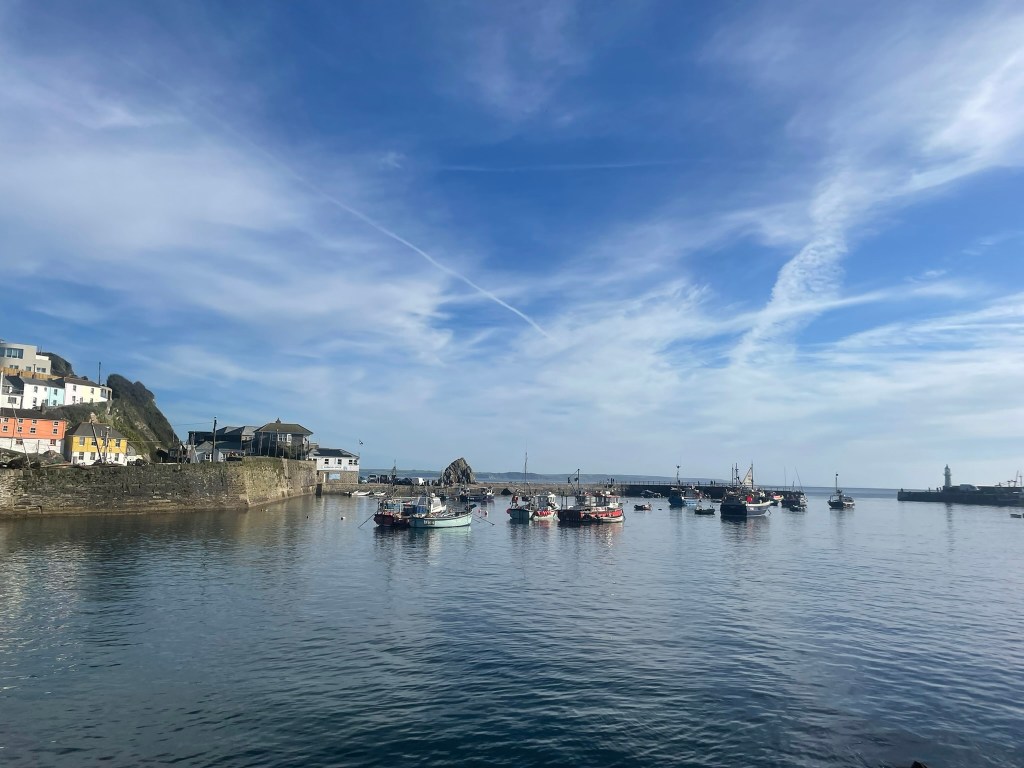
Mevagissey Harbour, Cornwall / Porth Lannvorek Kernow, photo author’s own

Learning Kernewek: Month 1 – Rebuilding

A Language Project in Practice (10 January – 11 February 2026)

Thirty-two journal entries.
Around fifteen hours of structured study.
Two missed days.

That is the practical shape of Month 1.

In my previous post, I described this as both a personal language commitment and a small research project into how revived languages are learned in practice. After one month of daily journalling, patterns are already visible.


Reconstructing Grammar

As I had previously studied some Cornish, one term of weekly online lessons and a 15 lesson course with SSIW, much of this month involved reconstruction rather than acquisition.

Vocabulary resurfaced relatively easily. Grammar required more deliberate rebuilding. Much of that rebuilding happened through repetition of DKB lessons, revisiting SSIK material, and occasional checks in the Gerlyver dictionary to clarify differences between Middle and Late forms.

For example:

Yma marth dhymm
(There is surprise to me.)

This structure mirrors Welsh patterns and once felt natural. Re-establishing that naturalness required repetition.

Month 1 was less about learning new material and more about stabilising an internal system that had partly faded.


Negotiating Variation

Modern Cornish presents learners with revived varieties. Throughout the month, I found myself moving between Middle and Late Cornish forms.

Sometimes the differences are small but noticeable. Words such as lemmin versus lebmin for “now,” or slight shifts in pronunciation, subtly change how the language feels when spoken aloud. As a Welsh speaker, Middle Cornish feels more intuitive and reduces the effort needed to produce the language.

This negotiation is not simply technical. It affects fluency, confidence, and how one situates oneself within a revived language community.


A Persistent Difficulty: “I Know”

The clearest recurring difficulty was with small everyday phrases such as:

Mi a hora fi (I know)
Ne a hora ni (We don’t know)
Ne a hora ni travyth eta (We don’t know anything about it.)

These expressions appear simple, but they sit at the centre of ordinary conversation. They involve negation, word order, rhythm, and agreement. For reasons I am still untangling, they proved stubborn.

The main strategy so far has simply been repetition, returning to the same lesson rather than rushing forward. Interestingly, this difficulty emerged only after simpler patterns had begun to settle. It feels less like a setback and more like moving into a new layer of the language.


Welsh as Scaffold

Welsh is always present in this process.

Cognates such as moy (more) and familiar constructions often make new material easier to grasp. At times Welsh pronunciation slips in. More often, it provides reassurance.

The experience is not one of one language interfering with another. It feels more like working within a shared Brythonic space.


From Internal Practice to Social Intention

Late in the month, a new type of sentence appeared in my journal:

My a vinca ty dha dhalath kewsel Kernewek genovi
(I would like you to start speaking Cornish with me.)

That sentence points outward. It imagines conversation rather than rehearsal.

Access to a regular Cornish-speaking community remains limited for me, so imagined dialogue often precedes real interaction. For a revived minority language, that outward turn feels significant.


What Month 1 Achieved

Month 1 did not produce fluency.

It produced:

  • Clear awareness of what feels unstable
  • Reduced anxiety around mutation and word order
  • A workable position within Middle and Late variation
  • A sustainable daily learning rhythm
  • The beginnings of communicative intent

In short, it built a framework.


Looking Forward

Month 2 may turn out to be less about learning new material and more about settling what has already begun. The phrases that resisted in Month 1, especially everyday ones like “I know” and “I don’t know,” might become easier with repetition.

I may repeat some recent lessons rather than moving on immediately, and perhaps begin reading short texts aloud to see what carries over into speech. It will be interesting to notice whether the language starts to feel a little less constructed and a little more automatic.

For now, the aim is not speed or fluency, but steadiness.

Trebanessa!
Kevin


Glossary & Context

  • DKB (Desky Kernôwek Bew) – audio-based Cornish course
  • SSIK (SaySomethingInCornish) – speaking-focused methodology
  • Bora Brav – accessible Cornish textbook
  • Gerlyver Kernewek – online Cornish dictionary

Varieties:
Modern Cornish draws on historical stages, particularly Middle Cornish (c. 1200–1600) and Late Cornish (17th–18th century). Contemporary learners often encounter both.

A new year a new Language?

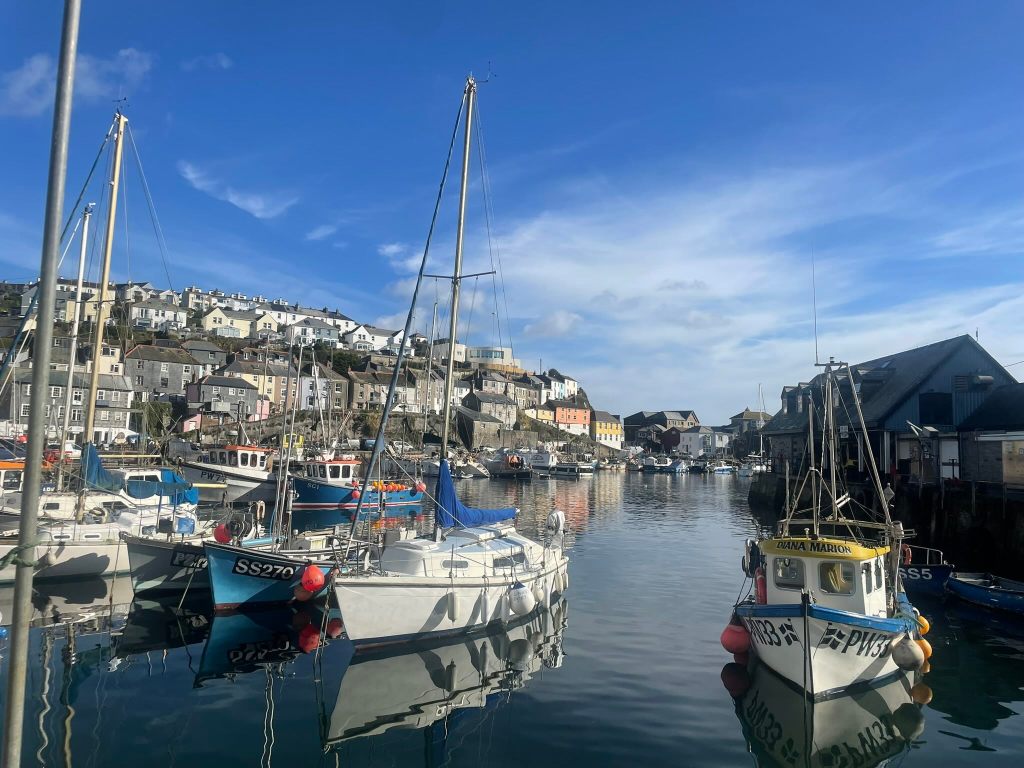
Porth Lannwydhek, Mevagissey Harbour, photo: author’s own.

Learning Kernewek: A Language Project, and a Research Journey

A Language Project in Practice – Projeth Yeth yn Praktis

In 2026, I have decided to return seriously to learning Kernewek (Cornish). I am deliberately avoiding calling this a “New Year’s resolution”, partly because I know my relationship with Cornish has already been characterised by enthusiasm, pauses, restarts, and reflection. Rather than seeing that as a failure, I have decided to make it the point, well partly. This blog will document an auto ethnographic research project based on my experience of learning Cornish. It will explore how I learn it, why I sometimes stop, what motivates me, what frustrates me, and how different teaching approaches, materials, and varieties of the language shape that experience.

Not a beginner, certainly not fluent

I am not a complete beginner. I previously completed a short fifteen lesson Cornish course using the Say Something in Welsh methodology, which I enjoyed enormously. I have long been drawn to approaches that prioritise active recall, spaced repetition, and early speaking, with minimal explicit grammar instruction. That approach worked well for me when learning Welsh, and I found it engaging and motivating in Cornish too, although the course itself felt too short to sustain longer term progress. By contrast, I also took a more traditional Cornish course at a couple of years ago. While I value formal learning environments, and I’m a language teacher myself, I found this experience much less enjoyable. The emphasis on vocabulary organised by semantic categories, for example learning all weather types in a single lesson, felt a little demotivating at such an early stage. It did not reflect how I believe people actually acquire language, and it offered relatively little opportunity to speak, which is something I personally find crucial, even at beginner level. These contrasting experiences made me increasingly interested not just in learning Cornish, but in examining how different pedagogical assumptions affect motivation, confidence, and persistence.

Courses, books, and community

Alongside courses, I have been exploring different learning resources. I am currently working with an extremely useful Cornish course, Desky Kernôwek Bew (DKB), created by Daniel Prohaska and very kindly made available for free.  DKB uses a methodology similar to Say Something in Welsh (SSIW) and consists of twenty six lessons. I have also been using two textbooks. The first is Bora Brav by Polin Prys, which I find accessible and engaging. The second is Desky Kernowek by Nicholas Williams, which I see more as a reference grammar than a learner friendly textbook. I have also begun to engage, cautiously, with the Cornish speaking community. There is a group of learners and speakers who meet weekly in Plymouth, Aberplymm in Cornish, which I have attended once and hope to return to. However, distance makes regular participation difficult. Community access, or the lack of it, is itself an important part of this project.

Choosing a variety: Middle or Late Cornish?

One early surprise was discovering that there is not just one Cornish to learn. Learners are often faced with a choice between different revived or reconstructed varieties, particularly Middle Cornish, roughly from 1200 to 1600, and Late Cornish. After some exploration and a lot of confusion, I found myself gravitating towards Middle Cornish, especially in terms of pronunciation. This was a practical decision, because as a Welsh speaker, Middle Cornish felt closer to me and reduced the cognitive load involved in trying to produce the language aloud. That choice, and the fact that learners must make such choices at all, raises interesting questions about authenticity, comfort, confidence, and prior linguistic experience, particularly for learners who already speak Welsh.

Why Cornish? Why now?

So why Cornish, and why the stop start history? I am learning Cornish because I love languages, because I have deeply enjoyed learning Welsh, and because I live in Devon, geographically closer to Cornwall than to Wales. I am also drawn to the idea of Cornwall, and perhaps Devon too, reclaiming its Brythonic linguistic inheritance. OK, so I’m an idealist.  At the same time, I am very aware that my motivation for learning Cornish is not as strong or as emotionally grounded as my motivation for learning Welsh. Rather than ignoring that fact, this project takes it seriously. How does motivation fluctuate over time? How do pedagogy, materials, language variety, and community access shape that motivation? And how does being an experienced language learner influence expectations, frustrations, and enjoyment?

About this project

Methodologically, this is an auto ethnographic, longitudinal project. I will be using learning journals, reflections on speaking practice, notes on materials, and observations from community engagement as data. The aim is not to prove that one method is better than another, but to explore how method and learner fit operates in the context of a revived minority language. This blog will function both as a learning log and as a space for analysis. Some posts will be reflective, some more analytical, and some simply descriptive. Together, they will form the basis of a small scale research study into motivation, pedagogy, and identity in learning Kernewek. If you are interested in Cornish, language learning, minority languages, or how adults actually experience learning languages outside idealised classroom models, I hope you will find something of value here.

An Dalleth. The Beginning. 

Are non-native accents a problem?

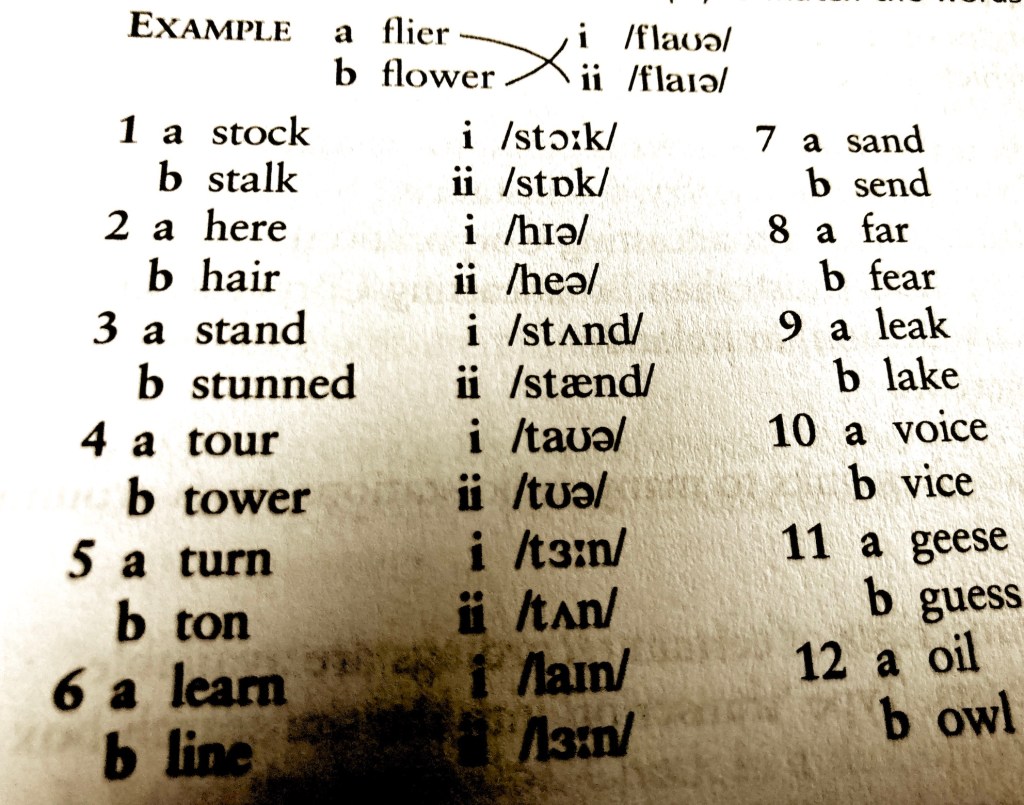
Source: English Pronunciation in Use, Advanced, Martin Hewings, Cambridge

I am often asked by students to help them improve their English accents. I usually respond that accents are only really a problem if they are a barrier to communication. That is if they prevent people from understanding the speaker. However, this answer rarely satisfies those students who are self-conscious about their English language skills. Different first languages tend to have different impacts on the way non-native speakers pronounce English. I will look at different languages’ influence in greater depth over the next few weeks, but for now, I will provide a brief introduction to the subject.

The impact of a non-native speaker’s first language on their English pronunciation varies. Firstly, phonological differences in native languages can influence sounds produced in English, leading to accents. For example, speakers of languages with different phonetic inventories may find certain English sounds challenging, such as the sounds associated with the letters ‘th’. Additionally, intonation patterns and stress placement can be affected by the native language, influencing overall pronunciation. Hence, native French speakers’ tendency to stress the final syllable of words. However, with practice and exposure, individuals can improve their English pronunciation. As, I mentioned above, over the next few weeks, I will be covering how different languages influence speakers’ pronunciation of English.

Thanks for reading.

Kevin

Second language anxiety

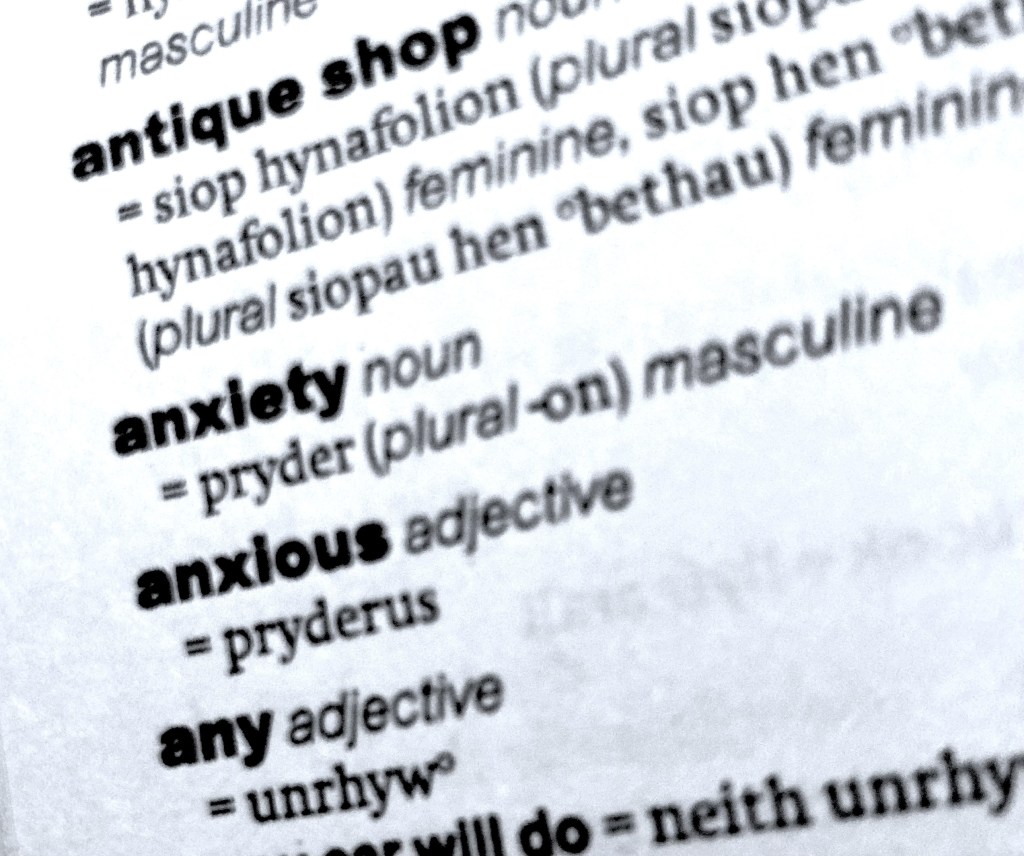
Photo source: Modern Welsh Dictionary, ed. Gareth King, Oxford University Press

Hello again,

I frequently come across students who are really nervous about speaking English even if they actually speak English really well. In fact, I was a little like that too, especially when I was learning French. I read ‘Le Monde’ every day and developed a wide vocabulary. However, I hated making mistakes when I spoke. So much so that I rarely said anything at all in classes and even less when visiting France. I now see what a mistake this was. Indeed, I only really overcame this when I started learning Welsh and the teacher told me not to worry about grammar too much and that it was okay to make mistakes (thanks to the SSIW crew and Nia!). So, here are a few tips for those, like I used to be, anxious about speaking in another language.

  1. Practice Speaking: Don’t be afraid to make mistakes. Speaking is a crucial part of language learning. Find language exchange partners or join language meet-up groups to practice with native speakers.
  2. Create a Supportive Environment: Let friends and family know about your language learning journey. Having a support system can boost your confidence and motivation.
  3. Focus on Fluency, Not Perfection: Remember that language learning is a gradual process. Aim for fluency and effective communication rather than perfection. Perfection can come later, but it won’t come first especially if you are too anxious to speak the language.
  4. Learn from Mistakes: Mistakes are a natural part of the learning process. Instead of dwelling on them, use them as opportunities to learn and improve.
  5. Have fun: Try and do something you like doing, reading, watching a TV series, or even just having a chat, but do it in your target language, not in your native tongue.

Hope you find these tips helpful. I look forward to any further thoughts or comments.

All the best!

Kevin