A Language Project in Practice – Ragdres Yeth yn Praktis
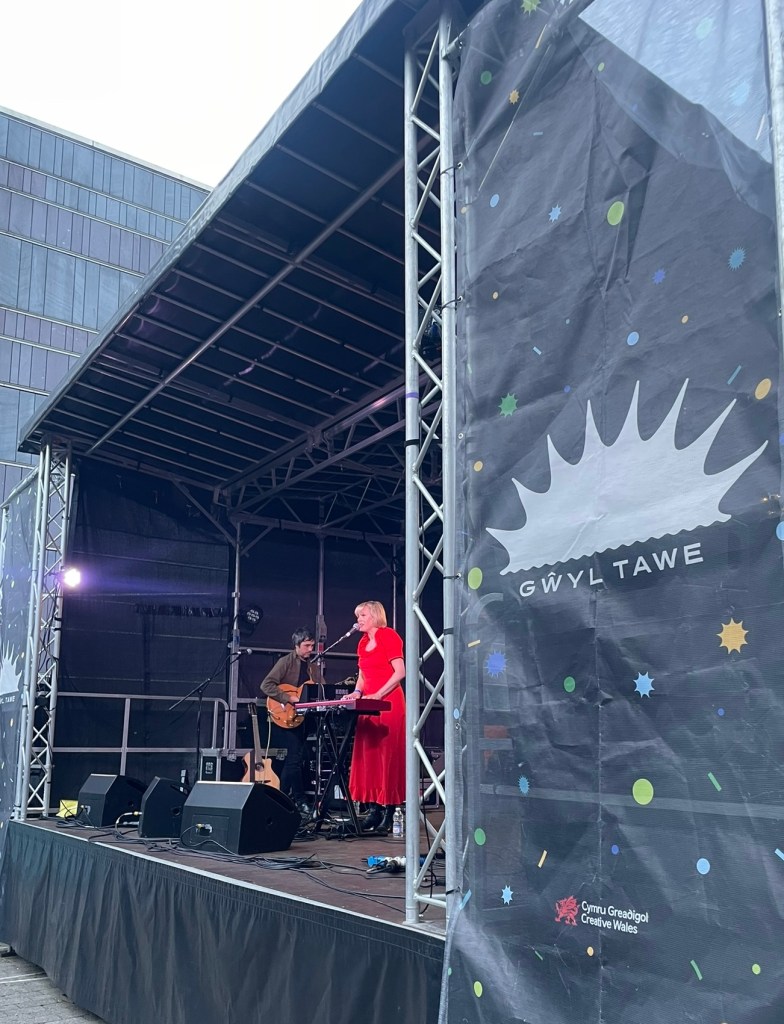
Gwenno, Gŵyl Tawe, Abertawe, 2026. Photo author’s own.
Dydh da.
Pymp mis a dhysk Kernewek a veu passys lemmyn.
An mis ma a omglewas differens aral. Mars o Mis 4 a-dro dhe dhyski pesya gans ansikkerder, Mis 5 a omglewas a-dro dhe dheves yn bywydh gwirion.
Good day.
Five months of learning Cornish have now passed.
This month felt different again. If Month 4 was about learning how to live with uncertainty, Month 5 was about seeing the language appear beyond learning itself.
For the first time, Cornish increasingly felt less like something I studied and more like something I encountered.
The language began appearing in books, songs, WhatsApp discussions, festivals, and everyday conversations.
At times, it felt as though the project was moving beyond language learning and into participation.
Finishing Level 3
One obvious milestone this month was completing SSIW Level 3.
Crossing that finish line felt significant, although perhaps not for the reason I expected.
Earlier stages of the project often felt dominated by grammar: learning sentence patterns, understanding mutations, handling conditionals, and gradually becoming comfortable with increasingly complex structures.
By the time I reached the end of Level 3, however, I realised that many of those structures no longer felt new.
They were not always easy, but they felt familiar.
That familiarity created a different kind of confidence.
The challenge was increasingly becoming not whether I could build sentences, but which words I wanted to put inside them.
From Grammar to Vocabulary
A noticeable shift this month was the growing importance of thematic vocabulary.
Returning to some of the older SSIW material introduced areas such as:
- body parts
- household objects
- emotions
- opinions
- disagreement
- personal history
Words increasingly arrived in clusters rather than isolation.
For example:
- leuv (hand)
- bregh (arm)
- troos (foot)
or:
- tybi (think)
- ragweles (foresee)
- dadhla (argue)
This felt different from earlier months.
Previously, vocabulary often seemed to serve grammar.
Now grammar increasingly served communication.
The language was becoming organised around real-world topics rather than abstract structures.
Welsh, Cornish, and Productive Guessing
Welsh continues to play a central role in my learning process.
The relationship, however, feels increasingly sophisticated.
Earlier in the project, Welsh mainly provided reassurance: familiar words, recognisable patterns, and useful shortcuts.
This month I found myself using Welsh more strategically.
Instead of asking:
“What is the Cornish translation?”
I increasingly found myself asking:
“What would a Brythonic language probably do here?”
That small change matters.
It encourages hypothesis-building rather than translation.
Sometimes those guesses were correct.
Sometimes they were not.
But increasingly they allowed communication to continue.
Perhaps more importantly, they helped Cornish feel like a system with its own internal logic rather than a collection of individual facts to memorise.
When Reading Starts to Work
One of the most encouraging moments this month came through reading.
I began working through Tintin: An Kanker ha’y Dhiwbaw Owrek and discovered something surprising.
Many of the structures felt immediately familiar.
Expressions that would have seemed completely inaccessible only a few months ago suddenly appeared understandable.
Of course, there were still unknown words.
There were still frequent dictionary checks.
But for the first time, the experience felt less like decoding and more like reading.
That distinction is important.
It suggested that input from multiple sources – SSIW lessons, community discussions, music, and reading – was beginning to converge into a single linguistic system.
From Learner to Participant
The strongest theme of the month was probably community.
Cornish increasingly appeared outside formal study.
Through WhatsApp groups, online discussions, festivals, reading, music, and social contacts, the language started to occupy a more natural place in everyday life.
Several experiences stood out.
Attending Gwenno’s performance at Gŵyl Tawe provided another opportunity to hear Cornish in a cultural setting.
Conversations surrounding the Prayer Book Rebellion led to deeper reflections about language suppression and revival.
Meanwhile, debates within Cornish-language spaces highlighted questions of identity, ownership, and belonging.
What struck me most was not necessarily the content of these discussions.
It was the fact that I could increasingly follow them.
A particularly satisfying milestone was realising that WhatsApp messages written by Cornish speakers no longer required painstaking word-by-word translation.
Meaning often emerged naturally.
That felt like a small but genuine breakthrough.
A Language or a Cultural Ecosystem?
Earlier in the project, Cornish often felt like a language course.
This month it increasingly felt like something much larger.
History appeared.
Politics appeared.
Music appeared.
Questions of identity appeared.
The language seemed less like a set of lessons and more like a cultural ecosystem.
This was especially noticeable in discussions about the Cornish revival, the Prayer Book Rebellion, and wider questions about language ownership and community.
Learning Cornish increasingly feels like entering a conversation that began long before I arrived.
Looking Ahead
At the end of Month 5, the project feels less focused on grammar and more focused on participation.
There are still plenty of linguistic challenges ahead.
Vocabulary remains vast.
Reading remains slow.
Authentic speech can still move far faster than I would like.
But the language is beginning to feel embedded within a wider network of people, places, books, music, and ideas.
Perhaps the most important development this month is that Cornish no longer feels confined to study sessions.
It is beginning to appear naturally in everyday life.
And that may be one of the clearest signs that a language is becoming real.
Ha lemmyn yth esov ow mos yn rag, ny yn unnig gans an yeth hy honan, mes gans an gemeneth a-dro dhedhi.
And now I move forward, not only with the language itself, but with the community around it.
Meur ras!
Trebanessa!
Month 5 Vocabulary
Some words and expressions that stood out this month:
- leuv — hand
- bregh — arm
- troos — foot
- tybi — think, suppose
- ragweles — foresee
- dadhla — argue
- skerys — angry
- yntanys — excited
- isel — low, depressed
- alhwedh — key
- esedhva — living room
- fortunys — fortunate
- deskordya — disagree
Research Note – Month 5 (for those interested in the learning process)
Learning process
Transition from structured course progression toward broader linguistic participation.
Key linguistic developments
- Completion of SSIW Level 3
- Expansion of thematic vocabulary domains
- Increased use of productive guessing strategies
- Growing confidence in communicative approximation
- Continued development of conditionals and imperfect forms
Cross-linguistic interaction
- Welsh remains a major scaffold language
- Increasingly strategic rather than automatic transfer
- Growing awareness of lexical layers within Cornish
- Continued development of a broader Brythonic linguistic repertoire
Learning behaviour
- More selective use of repetition
- Strategic prioritisation of useful vocabulary
- Greater tolerance of ambiguity
- Stronger trust in communicative momentum over perfection
Sociolinguistic dimension
- Increased engagement with authentic Cornish materials
- Growing participation in community discussions
- Greater exposure to cultural and historical aspects of revival
- Awareness of speaker scarcity as a continuing challenge
Emerging research themes
- Participation versus observation in revived-language communities
- Authentic input and comprehension development
- Strategic multilingualism in Brythonic language learning
- Identity formation through cultural participation
- The transition from language learning to language community

 mondolingo