A Language Project in Practice – Projeth Yeth yn Praktis
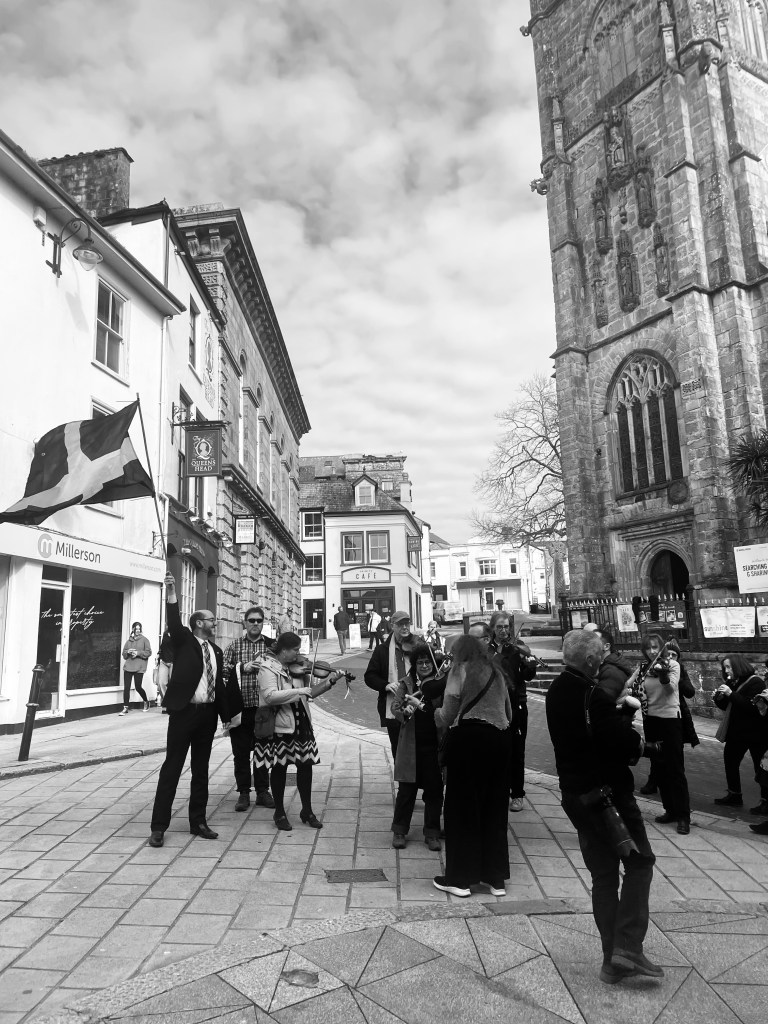
St Piran’s Day, St Austell, Gool Sen Peran, Sen Austel – photo author’s own
Dydh da.
Dew mis a dhysk Kernewek yw passys lemmyn.
Yn an termyn ma my a dhyskys meur: pyth a help dhymm dyski, pyth yw an haval dhe Gymraeg, ha pyth sort Kernewek my a vynn leverel.
Hello (good day).
Two months of learning Cornish have now passed.
During this time I have learned a lot: what helps me learn, what is similar to Welsh, and what kind of Cornish I want to speak.
Consolidating Patterns
At the end of the second month of this project, a number of patterns are beginning to emerge in my experience of learning Kernewek.
During February I continued working steadily through the Desky Kernôwek Bew (DKB) course, usually studying for around twenty to thirty minutes a day. The routine remained quite consistent: active recall exercises, repetition lessons, and short spoken reflections recorded immediately afterwards.
A simple rule has guided the process. If I can reproduce roughly eighty percent of the material, I move on. This prevents getting stuck in endless repetition and keeps the language moving forward.
Certain grammatical patterns have begun to settle quite naturally. One example is the expression of necessity:
Res yw dhymm – I have to
Yw res dhymm? – Do I have to?
These kinds of short constructions are now becoming fairly automatic. Longer, multi-clause sentences remain more difficult, especially when they appear quickly in spoken input. This seems typical of spoken-first learning: the building blocks settle first, while more complex structures follow later.
The Persistent Puzzle of “About It”
Like many learners, I seem to have developed a few personal “problem phrases”.
During this month, one of these was the various expressions meaning “about it.” Although I could usually understand the meaning, the exact phonological form proved surprisingly difficult to anchor. Even after several repetitions I sometimes struggled to hear the phrase clearly enough to reproduce it confidently.
This difficulty was not really about vocabulary itself. New words themselves were usually easy enough to learn. Instead the challenge seemed to lie in hearing and remembering small grammatical chunks embedded inside longer sentences.
Gradually the phrase has begun to sound more familiar, but it still feels slightly unstable.
Welsh as Bridge and Interference
Throughout the month the influence of Welsh has been constant.
In many cases it has been extremely helpful. Vocabulary parallels such as:
mergh / merch – daughter
mab / mab – son
provide immediate recognition and make new words easier to remember.
More interestingly, the logic of the language often feels familiar. Some Cornish sentence patterns have a distinctly Welsh grammatical feel, even when the vocabulary itself differs.
At the same time, Welsh occasionally interferes. For example, I often feel the instinctive urge to insert the Welsh particle yn before verbs in progressive constructions, even though this does not belong in Cornish.
Interestingly, the influence has not been entirely one-directional. On one occasion I noticed Cornish words briefly appearing when I was trying to speak Welsh (a-vorow instead of Welsh yfory), suggesting that the two Brythonic systems are beginning to interact in both directions.
Learning a closely related language therefore seems to create a constant balancing act between helpful transfer and subtle interference.
Pronunciation and Linguistic Identity
Perhaps the most important personal development this month has been clarifying which variety of Cornish I want to speak.
The DKB course is largely based on Late Cornish, but as the course progressed I increasingly felt drawn back toward Middle Cornish, which I had encountered previously. The main reason is phonological familiarity. Middle Cornish pronunciation seems closer to Welsh, particularly the Welsh I speak with a South Wales accent.
This matters to me for reasons of identity. I do not want to adopt an artificial Cornish accent. I would rather speak Cornish in a way that feels authentic to my own linguistic background: a Welsh-speaker from Glamorgan speaking Kernewek.
In that sense, learning Cornish is becoming less about reproducing a standard pronunciation and more about finding a personal voice within the language.
Hearing Cornish in the Wild
Actual opportunities to speak Cornish have still been limited, which is perhaps not surprising given the small number of speakers.
However, at the beginning of March I attended Gool Kevrennow in St Austell, a Cornish cultural festival celebrating Cornish-Welsh connections. There I heard at least some Kernewek spoken in everyday interactions: phrases such as myttin da, meur ras, pur dha, and splann. I even managed to mumble a hesitant dydh da at one point.
Although brief, it was encouraging simply to hear the language used in a social setting.
The festival emphasised the deep historical connections between Wales and Cornwall: linguistic, cultural, economic, religious, and musical. Both regions share a long Brythonic heritage, and historically both were often described from outside as part of the wider category of Welsh, in the old Germanic sense meaning “foreign” or “non-Germanic peoples”.
Experiencing the cultural context reinforced why learning the language matters to me, and, although I spoke very little Cornish myself, attending the festival felt like a tentative first step into the wider language community.
Expanding the Learning Environment
Towards the end of the month my learning activities began to widen beyond the course itself.
I have started reading a Cornish translation of Tintin, An Kanker ha’y Dhiwbaw Owrek (The Crab with the Golden Claws). Previously I found it extremely difficult, but with the help of digital tools and translation assistance it has become a much more accessible resource.
I have also been exploring other materials: listening to Cornish music, following Cornish-language news broadcasts, and using a small pocket dictionary and grammar guide.
Another interesting discovery came from a talk at Gool Kevrennow about digital resources. The Gerlyver online dictionary, which I have already used, and a related Kernewek corpus project, which I haven’t, were mentioned, as well as Cornish courses on the Memrise platform. Given the small size of the language community, digital tools clearly have a potentially important role in supporting learners.
Looking Ahead
As the final lessons of the DKB Level 1 course approached, I noticed a slight drop in motivation to perfect individual clauses, perhaps reflecting the sense of transition between structured learning and the next stage of the project. This feels like a natural point to pause and reflect.
Rather than immediately starting another structured course, the next phase may involve more reading, listening, and eventually conversation practice. I have already signed up for an online Cornish day course in April, which should provide more opportunities to use the language actively.
I am also considering the possibility of starting a small Cornish conversation group in Exeter, perhaps meeting once or twice a month. Please get in touch if you are interested.
Finally, one unexpected realisation during this month is how important the research dimension of this project has become. Committing to documenting the process has strengthened my motivation. The project is no longer just about learning a language; it is also about understanding the experience of learning it.
And increasingly, it feels like that the journey may lead somewhere I had not originally anticipated.
Ha lemmyn yth esov ow talleth an nessa kamm yn ow hentr dhe dhyski Kernewek.
Meur ras!
And now I am beginning the next step in my journey of learning Cornish.
Thank you.
Trebanessa!
Month 2 Vocabulary
Here are some words and expressions that I’ve used a lot this month:
- res yw dhymm — I have to
- mergh — daughter
- mab — son
- a-vorow — tomorrow
- dydh da — hello / good day
- meur ras — thank you
- pur dha — very good
- splann — excellent
- termyn — time
- dalleth — to begin
 mondolingo