Learning Kernewek: Month 2 – Patterns, Identity, and First Encounters

A Language Project in Practice – Projeth Yeth yn Praktis
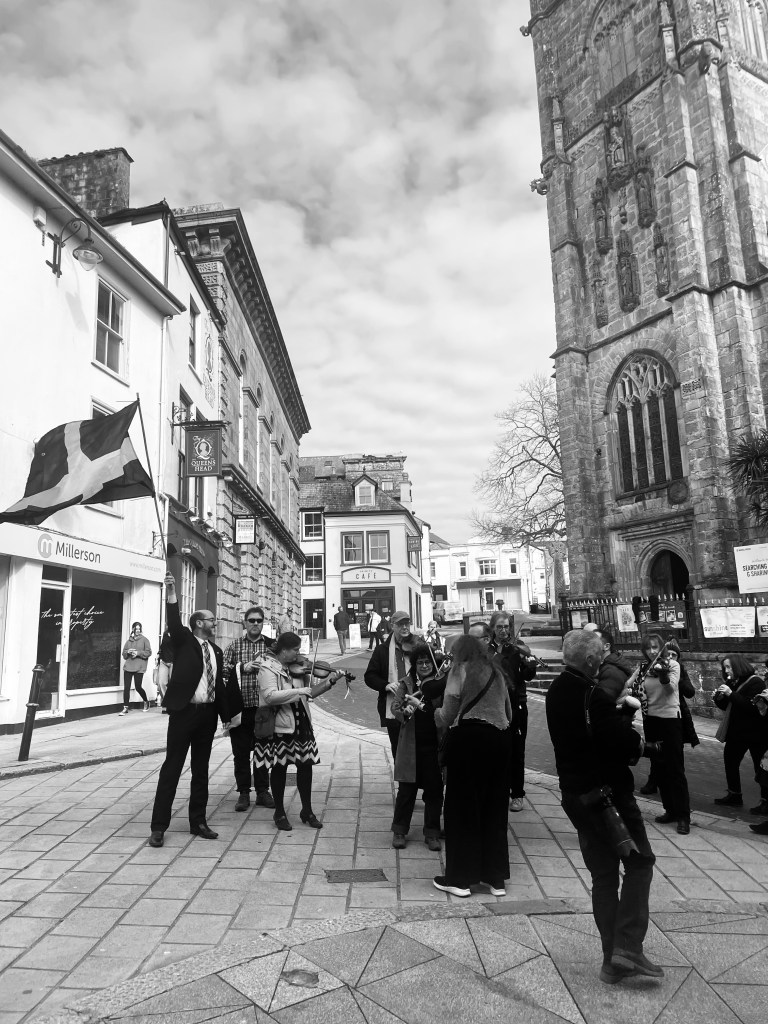
St Piran’s Day, St Austell, Gool Sen Peran, Sen Austel – photo author’s own

Dydh da.

Dew mis a dhysk Kernewek yw passys lemmyn.

Yn an termyn ma my a dhyskys meur: pyth a help dhymm dyski, pyth yw an haval dhe Gymraeg, ha pyth sort Kernewek my a vynn leverel.

Hello (good day).

Two months of learning Cornish have now passed.

During this time I have learned a lot: what helps me learn, what is similar to Welsh, and what kind of Cornish I want to speak.

Consolidating Patterns

At the end of the second month of this project, a number of patterns are beginning to emerge in my experience of learning Kernewek.

During February I continued working steadily through the Desky Kernôwek Bew (DKB) course, usually studying for around twenty to thirty minutes a day. The routine remained quite consistent: active recall exercises, repetition lessons, and short spoken reflections recorded immediately afterwards.

A simple rule has guided the process. If I can reproduce roughly eighty percent of the material, I move on. This prevents getting stuck in endless repetition and keeps the language moving forward.

Certain grammatical patterns have begun to settle quite naturally. One example is the expression of necessity:

Res yw dhymm – I have to
Yw res dhymm? – Do I have to?

These kinds of short constructions are now becoming fairly automatic. Longer, multi-clause sentences remain more difficult, especially when they appear quickly in spoken input. This seems typical of spoken-first learning: the building blocks settle first, while more complex structures follow later.

The Persistent Puzzle of “About It”

Like many learners, I seem to have developed a few personal “problem phrases”.

During this month, one of these was the various expressions meaning “about it.” Although I could usually understand the meaning, the exact phonological form proved surprisingly difficult to anchor. Even after several repetitions I sometimes struggled to hear the phrase clearly enough to reproduce it confidently.

This difficulty was not really about vocabulary itself. New words themselves were usually easy enough to learn. Instead the challenge seemed to lie in hearing and remembering small grammatical chunks embedded inside longer sentences.

Gradually the phrase has begun to sound more familiar, but it still feels slightly unstable.

Welsh as Bridge and Interference

Throughout the month the influence of Welsh has been constant.

In many cases it has been extremely helpful. Vocabulary parallels such as:

mergh / merch – daughter
mab / mab – son

provide immediate recognition and make new words easier to remember.

More interestingly, the logic of the language often feels familiar. Some Cornish sentence patterns have a distinctly Welsh grammatical feel, even when the vocabulary itself differs.

At the same time, Welsh occasionally interferes. For example, I often feel the instinctive urge to insert the Welsh particle yn before verbs in progressive constructions, even though this does not belong in Cornish.

Interestingly, the influence has not been entirely one-directional. On one occasion I noticed Cornish words briefly appearing when I was trying to speak Welsh (a-vorow instead of Welsh yfory), suggesting that the two Brythonic systems are beginning to interact in both directions.

Learning a closely related language therefore seems to create a constant balancing act between helpful transfer and subtle interference.

Pronunciation and Linguistic Identity

Perhaps the most important personal development this month has been clarifying which variety of Cornish I want to speak.

The DKB course is largely based on Late Cornish, but as the course progressed I increasingly felt drawn back toward Middle Cornish, which I had encountered previously. The main reason is phonological familiarity. Middle Cornish pronunciation seems closer to Welsh, particularly the Welsh I speak with a South Wales accent.

This matters to me for reasons of identity. I do not want to adopt an artificial Cornish accent. I would rather speak Cornish in a way that feels authentic to my own linguistic background: a Welsh-speaker from Glamorgan speaking Kernewek.

In that sense, learning Cornish is becoming less about reproducing a standard pronunciation and more about finding a personal voice within the language.

Hearing Cornish in the Wild

Actual opportunities to speak Cornish have still been limited, which is perhaps not surprising given the small number of speakers.

However, at the beginning of March I attended Gool Kevrennow in St Austell, a Cornish cultural festival celebrating Cornish-Welsh connections. There I heard at least some Kernewek spoken in everyday interactions: phrases such as myttin da, meur ras, pur dha, and splann. I even managed to mumble a hesitant dydh da at one point.

Although brief, it was encouraging simply to hear the language used in a social setting.

The festival emphasised the deep historical connections between Wales and Cornwall: linguistic, cultural, economic, religious, and musical. Both regions share a long Brythonic heritage, and historically both were often described from outside as part of the wider category of Welsh, in the old Germanic sense meaning “foreign” or “non-Germanic peoples”.

Experiencing the cultural context reinforced why learning the language matters to me, and, although I spoke very little Cornish myself, attending the festival felt like a tentative first step into the wider language community.

Expanding the Learning Environment

Towards the end of the month my learning activities began to widen beyond the course itself.

I have started reading a Cornish translation of Tintin, An Kanker ha’y Dhiwbaw Owrek (The Crab with the Golden Claws). Previously I found it extremely difficult, but with the help of digital tools and translation assistance it has become a much more accessible resource.

I have also been exploring other materials: listening to Cornish music, following Cornish-language news broadcasts, and using a small pocket dictionary and grammar guide.

Another interesting discovery came from a talk at Gool Kevrennow about digital resources. The Gerlyver online dictionary, which I have already used, and a related Kernewek corpus project, which I haven’t, were mentioned, as well as Cornish courses on the Memrise platform. Given the small size of the language community, digital tools clearly have a potentially important role in supporting learners.

Looking Ahead

As the final lessons of the DKB Level 1 course approached, I noticed a slight drop in motivation to perfect individual clauses, perhaps reflecting the sense of transition between structured learning and the next stage of the project. This feels like a natural point to pause and reflect.

Rather than immediately starting another structured course, the next phase may involve more reading, listening, and eventually conversation practice. I have already signed up for an online Cornish day course in April, which should provide more opportunities to use the language actively.

I am also considering the possibility of starting a small Cornish conversation group in Exeter, perhaps meeting once or twice a month. Please get in touch if you are interested. 

Finally, one unexpected realisation during this month is how important the research dimension of this project has become. Committing to documenting the process has strengthened my motivation. The project is no longer just about learning a language; it is also about understanding the experience of learning it.

And increasingly, it feels like that the journey may lead somewhere I had not originally anticipated.

Ha lemmyn yth esov ow talleth an nessa kamm yn ow hentr dhe dhyski Kernewek.

Meur ras!

And now I am beginning the next step in my journey of learning Cornish.

Thank you.

Trebanessa!

Month 2 Vocabulary

Here are some words and expressions that I’ve used a lot this month:

  • res yw dhymm — I have to
  • mergh — daughter
  • mab — son
  • a-vorow — tomorrow
  • dydh da — hello / good day
  • meur ras — thank you
  • pur dha — very good
  • splann — excellent
  • termyn — time
  • dalleth — to begin

Exploring Cornish Language Acquisition: Month 1 Review

A Language Project in Practice – Projeth Yeth yn Praktis

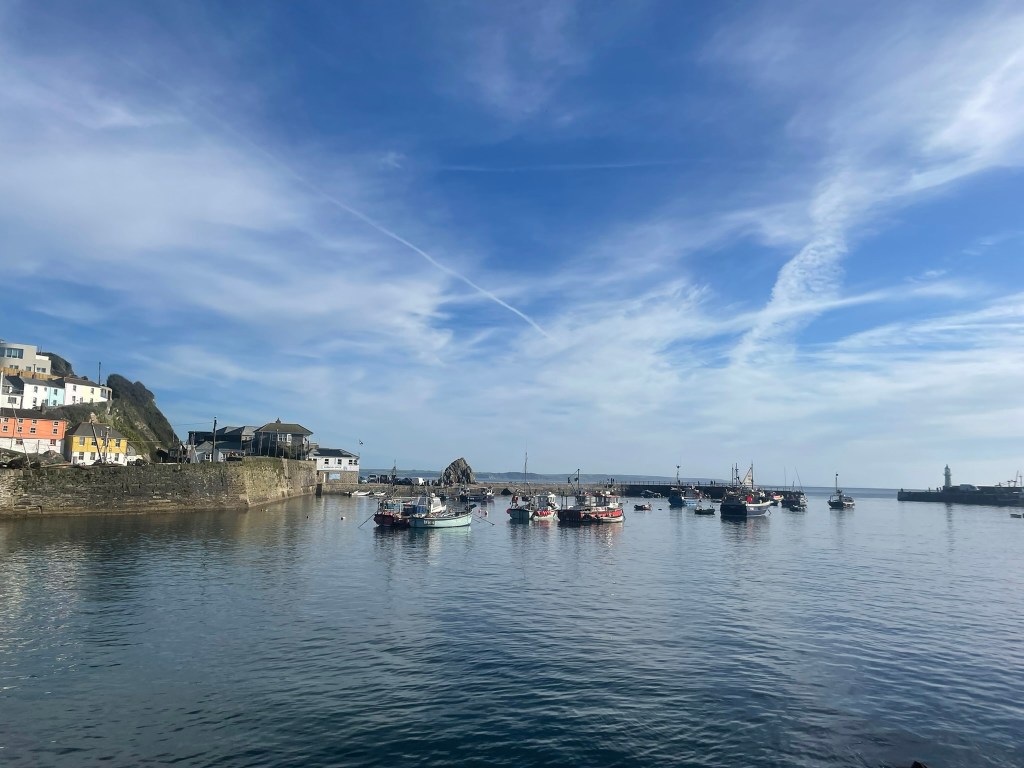
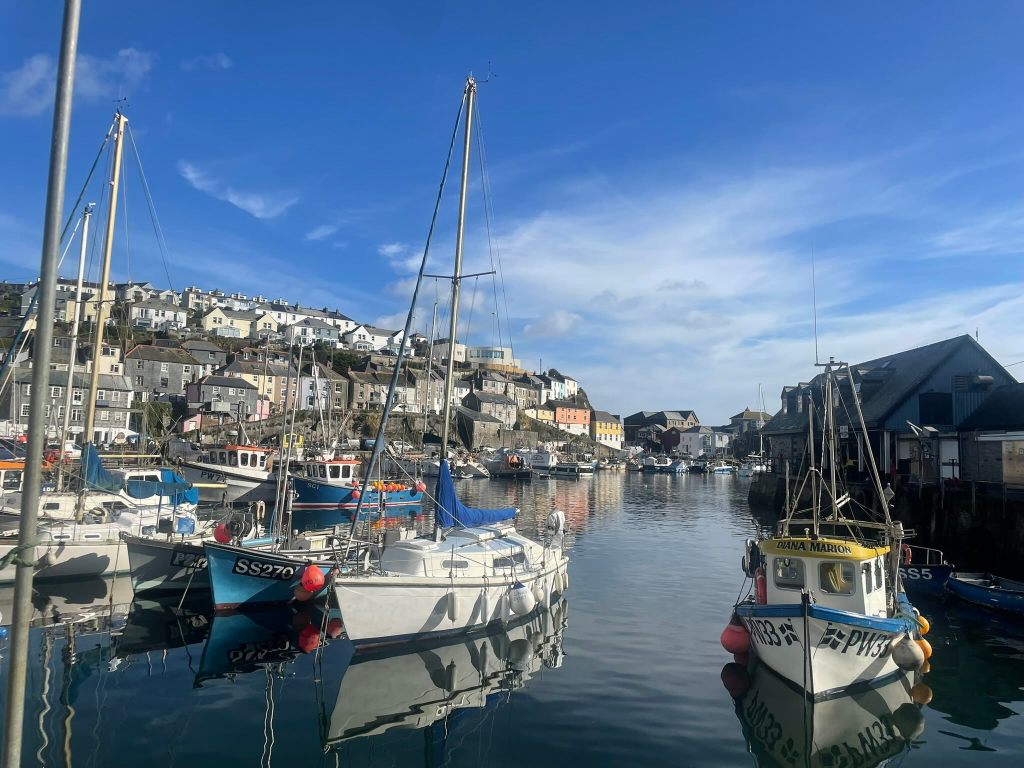
Mevagissey Harbour, Cornwall / Porth Lannvorek Kernow, photo author’s own

Learning Kernewek: Month 1 – Rebuilding

A Language Project in Practice (10 January – 11 February 2026)

Thirty-two journal entries.
Around fifteen hours of structured study.
Two missed days.

That is the practical shape of Month 1.

In my previous post, I described this as both a personal language commitment and a small research project into how revived languages are learned in practice. After one month of daily journalling, patterns are already visible.


Reconstructing Grammar

As I had previously studied some Cornish, one term of weekly online lessons and a 15 lesson course with SSIW, much of this month involved reconstruction rather than acquisition.

Vocabulary resurfaced relatively easily. Grammar required more deliberate rebuilding. Much of that rebuilding happened through repetition of DKB lessons, revisiting SSIK material, and occasional checks in the Gerlyver dictionary to clarify differences between Middle and Late forms.

For example:

Yma marth dhymm
(There is surprise to me.)

This structure mirrors Welsh patterns and once felt natural. Re-establishing that naturalness required repetition.

Month 1 was less about learning new material and more about stabilising an internal system that had partly faded.


Negotiating Variation

Modern Cornish presents learners with revived varieties. Throughout the month, I found myself moving between Middle and Late Cornish forms.

Sometimes the differences are small but noticeable. Words such as lemmin versus lebmin for “now,” or slight shifts in pronunciation, subtly change how the language feels when spoken aloud. As a Welsh speaker, Middle Cornish feels more intuitive and reduces the effort needed to produce the language.

This negotiation is not simply technical. It affects fluency, confidence, and how one situates oneself within a revived language community.


A Persistent Difficulty: “I Know”

The clearest recurring difficulty was with small everyday phrases such as:

Mi a hora fi (I know)
Ne a hora ni (We don’t know)
Ne a hora ni travyth eta (We don’t know anything about it.)

These expressions appear simple, but they sit at the centre of ordinary conversation. They involve negation, word order, rhythm, and agreement. For reasons I am still untangling, they proved stubborn.

The main strategy so far has simply been repetition, returning to the same lesson rather than rushing forward. Interestingly, this difficulty emerged only after simpler patterns had begun to settle. It feels less like a setback and more like moving into a new layer of the language.


Welsh as Scaffold

Welsh is always present in this process.

Cognates such as moy (more) and familiar constructions often make new material easier to grasp. At times Welsh pronunciation slips in. More often, it provides reassurance.

The experience is not one of one language interfering with another. It feels more like working within a shared Brythonic space.


From Internal Practice to Social Intention

Late in the month, a new type of sentence appeared in my journal:

My a vinca ty dha dhalath kewsel Kernewek genovi
(I would like you to start speaking Cornish with me.)

That sentence points outward. It imagines conversation rather than rehearsal.

Access to a regular Cornish-speaking community remains limited for me, so imagined dialogue often precedes real interaction. For a revived minority language, that outward turn feels significant.


What Month 1 Achieved

Month 1 did not produce fluency.

It produced:

  • Clear awareness of what feels unstable
  • Reduced anxiety around mutation and word order
  • A workable position within Middle and Late variation
  • A sustainable daily learning rhythm
  • The beginnings of communicative intent

In short, it built a framework.


Looking Forward

Month 2 may turn out to be less about learning new material and more about settling what has already begun. The phrases that resisted in Month 1, especially everyday ones like “I know” and “I don’t know,” might become easier with repetition.

I may repeat some recent lessons rather than moving on immediately, and perhaps begin reading short texts aloud to see what carries over into speech. It will be interesting to notice whether the language starts to feel a little less constructed and a little more automatic.

For now, the aim is not speed or fluency, but steadiness.

Trebanessa!
Kevin


Glossary & Context

  • DKB (Desky Kernôwek Bew) – audio-based Cornish course
  • SSIK (SaySomethingInCornish) – speaking-focused methodology
  • Bora Brav – accessible Cornish textbook
  • Gerlyver Kernewek – online Cornish dictionary

Varieties:
Modern Cornish draws on historical stages, particularly Middle Cornish (c. 1200–1600) and Late Cornish (17th–18th century). Contemporary learners often encounter both.

A new year a new Language?

Porth Lannwydhek, Mevagissey Harbour, photo: author’s own.

Learning Kernewek: A Language Project, and a Research Journey

A Language Project in Practice – Projeth Yeth yn Praktis

In 2026, I have decided to return seriously to learning Kernewek (Cornish). I am deliberately avoiding calling this a “New Year’s resolution”, partly because I know my relationship with Cornish has already been characterised by enthusiasm, pauses, restarts, and reflection. Rather than seeing that as a failure, I have decided to make it the point, well partly. This blog will document an auto ethnographic research project based on my experience of learning Cornish. It will explore how I learn it, why I sometimes stop, what motivates me, what frustrates me, and how different teaching approaches, materials, and varieties of the language shape that experience.

Not a beginner, certainly not fluent

I am not a complete beginner. I previously completed a short fifteen lesson Cornish course using the Say Something in Welsh methodology, which I enjoyed enormously. I have long been drawn to approaches that prioritise active recall, spaced repetition, and early speaking, with minimal explicit grammar instruction. That approach worked well for me when learning Welsh, and I found it engaging and motivating in Cornish too, although the course itself felt too short to sustain longer term progress. By contrast, I also took a more traditional Cornish course at a couple of years ago. While I value formal learning environments, and I’m a language teacher myself, I found this experience much less enjoyable. The emphasis on vocabulary organised by semantic categories, for example learning all weather types in a single lesson, felt a little demotivating at such an early stage. It did not reflect how I believe people actually acquire language, and it offered relatively little opportunity to speak, which is something I personally find crucial, even at beginner level. These contrasting experiences made me increasingly interested not just in learning Cornish, but in examining how different pedagogical assumptions affect motivation, confidence, and persistence.

Courses, books, and community

Alongside courses, I have been exploring different learning resources. I am currently working with an extremely useful Cornish course, Desky Kernôwek Bew (DKB), created by Daniel Prohaska and very kindly made available for free.  DKB uses a methodology similar to Say Something in Welsh (SSIW) and consists of twenty six lessons. I have also been using two textbooks. The first is Bora Brav by Polin Prys, which I find accessible and engaging. The second is Desky Kernowek by Nicholas Williams, which I see more as a reference grammar than a learner friendly textbook. I have also begun to engage, cautiously, with the Cornish speaking community. There is a group of learners and speakers who meet weekly in Plymouth, Aberplymm in Cornish, which I have attended once and hope to return to. However, distance makes regular participation difficult. Community access, or the lack of it, is itself an important part of this project.

Choosing a variety: Middle or Late Cornish?

One early surprise was discovering that there is not just one Cornish to learn. Learners are often faced with a choice between different revived or reconstructed varieties, particularly Middle Cornish, roughly from 1200 to 1600, and Late Cornish. After some exploration and a lot of confusion, I found myself gravitating towards Middle Cornish, especially in terms of pronunciation. This was a practical decision, because as a Welsh speaker, Middle Cornish felt closer to me and reduced the cognitive load involved in trying to produce the language aloud. That choice, and the fact that learners must make such choices at all, raises interesting questions about authenticity, comfort, confidence, and prior linguistic experience, particularly for learners who already speak Welsh.

Why Cornish? Why now?

So why Cornish, and why the stop start history? I am learning Cornish because I love languages, because I have deeply enjoyed learning Welsh, and because I live in Devon, geographically closer to Cornwall than to Wales. I am also drawn to the idea of Cornwall, and perhaps Devon too, reclaiming its Brythonic linguistic inheritance. OK, so I’m an idealist.  At the same time, I am very aware that my motivation for learning Cornish is not as strong or as emotionally grounded as my motivation for learning Welsh. Rather than ignoring that fact, this project takes it seriously. How does motivation fluctuate over time? How do pedagogy, materials, language variety, and community access shape that motivation? And how does being an experienced language learner influence expectations, frustrations, and enjoyment?

About this project

Methodologically, this is an auto ethnographic, longitudinal project. I will be using learning journals, reflections on speaking practice, notes on materials, and observations from community engagement as data. The aim is not to prove that one method is better than another, but to explore how method and learner fit operates in the context of a revived minority language. This blog will function both as a learning log and as a space for analysis. Some posts will be reflective, some more analytical, and some simply descriptive. Together, they will form the basis of a small scale research study into motivation, pedagogy, and identity in learning Kernewek. If you are interested in Cornish, language learning, minority languages, or how adults actually experience learning languages outside idealised classroom models, I hope you will find something of value here.

An Dalleth. The Beginning.