A Language Project in Practice – Projeth Yeth yn Praktis
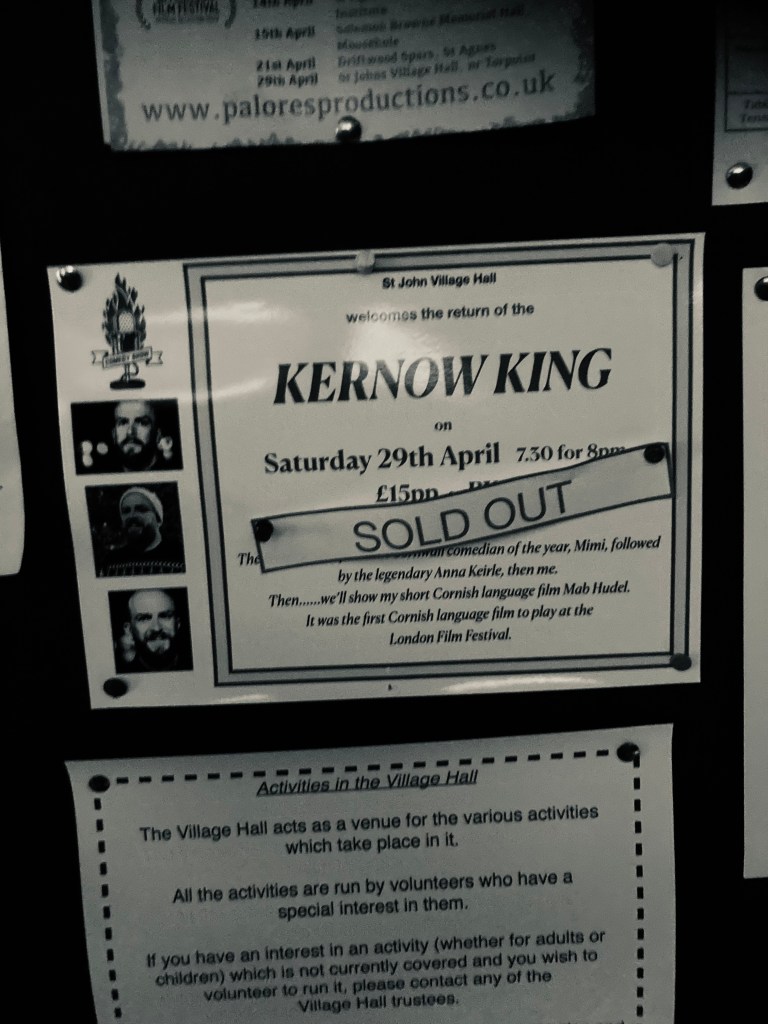
Noticeboard St John’s Village Hall – Photo – author’s own
Dydh da.
Tri mis a dhysk Kernewek a veu passys lemmyn.
Yn an termyn ma, yma chenjans dhe weles: nyns yw hemma yn unnig a-dro dhe lavarow ha patrymmow, mes a-dro dhe’n yeth ow mos dhe vos bev.
Hello (good day).
Three months of learning Cornish have now passed.
During this time, something has begun to change: this is no longer only about words and patterns, but about the language starting to feel alive.
From Patterns to Structure
At the end of the third month, the learning process has begun to shift in a noticeable way.
Earlier stages focused heavily on recognising and reproducing patterns. This month, those patterns have started to combine into longer and more flexible sentences. Structures that once felt like isolated chunks are gradually becoming tools for building meaning in real time.
Working through lessons now often involves multi-clause sentences, past tense constructions, and more complex forms such as:
Ny wodhas vy bos hi o kewsel Kernewek
(I didn’t know that she spoke Cornish)
These kinds of sentences are not always stable yet, but they represent a clear step forward. The language is becoming something I use, rather than something I repeat.
The “80% rule” continues to guide the process. As long as I can produce most of a structure, I move on. This has kept the learning dynamic and avoided the trap of over-perfection.
Welsh as System, Not Just Support
Welsh continues to play a central role, but its function is becoming more complex.
Earlier on, Welsh mainly acted as a bridge: helping with vocabulary and familiar structures. Now it feels more like a parallel system that I am constantly negotiating with.
Sometimes it supports production:
bledhyn / blwyddyn
pan / pan
At other times, it interferes:
expecting Welsh particles where Cornish does not use them, mixing verb–preposition patterns between the two languages
There are even moments where the influence goes in both directions, with Cornish forms briefly appearing when speaking Welsh.
What is emerging is not simply “transfer”, but something closer to a Brythonic linguistic space, where the boundaries between languages are present but permeable.
New Challenges: Grammar, Not Words
One of the clearest developments this month is that difficulty is shifting away from vocabulary and toward structure.
Two recurring challenges stand out:
- Negative indefinites
(e.g. den vyth – “nobody”) - Plural pronouns and agreement systems
(e.g. yth eson ni, yth esons i, yth esowgh hwi)
These require more real-time processing and are harder to stabilise than individual words.
Another interesting feature is the need to work around English concepts. Instead of directly translating “should”, for example, Cornish often prefers expressions closer to:
“I must”
“I need to”
“It would be better”
This reinforces the sense that learning the language involves adapting to a different structural logic, rather than mapping English directly onto Cornish.
Approximation and “Caveman Cornish”
Not every day has felt smooth.
There are moments when fluency drops, due to fatigue, distraction, or simply not feeling at one’s best. On one occasion, even familiar words slipped away and had to be reconstructed through cognates, such as rediscovering triya (“to try”) via its similarity to Welsh trio.
At times like this, I have found myself producing what I jokingly call “caveman Cornish”: simplified, approximate sentences built from whatever is available.
Surprisingly, this has been a positive development.
Rather than blocking communication, approximation allows the language to keep moving. It prioritises expression over accuracy and seems to help patterns settle more naturally over time.
From Study to Participation
The most important change this month has been the move toward participation.
Earlier contact with the language community was limited: reading messages, following discussions, observing from a distance. This month, that began to change.
Attending Sadorn Kernewek Warlinen, a full day of online talks and conversation sessions, was particularly significant. Hearing Cornish spoken in real time, across different speakers and contexts, made the language feel much less abstract.
I was still very much at the lower end of the proficiency range, but I was able to say a few things and be understood. That small shift, from passive exposure to active participation, felt important.
The experience also highlighted the realities of a revived language:
- variation in pronunciation and form
- small number of fluent speakers
- strong reliance on learners as part of the community
At the same time, it showed that communication is possible even within those constraints.
Expanding the Learning Environment
Learning this month has extended beyond structured lessons.
Vocabulary and patterns have come from:
- course input (SSIW)
- reading (Tintin in Kernewek)
- music (e.g. Gwenno)
- community interaction (online groups, events)
There was even a small but encouraging moment of noticing myself thinking briefly in Cornish on waking, a sign that the language may be beginning to embed itself more deeply.
The learning process now feels less like a course and more like an environment.
Looking Ahead
At the end of Month 3, the project feels different in kind, not just in degree.
It is no longer simply about learning Cornish as a system. It is about:
- operating within a Brythonic linguistic space
- managing transfer and interference
- participating, however tentatively, in a speech community
- developing a personal way of using the language
The next stage will likely involve more:
- writing (following advice from experienced speakers)
- conversation practice
- exposure to natural speech
Ha lemmyn yth esov ow mos yn rag dhe’n nessa kamm.
And now I am moving on to the next step.
Meur ras!
Trebanessa!
Month 3 Vocabulary
Here are some words and expressions that stood out this month:
den vyth — nobody
yth eson ni — we are
yth esons i — they are
yth esowgh hwi — you (plural) are
kemmys ha possybl — as much as possible
triya — to try
labourya yn tre — to work at home
spena termyn — to spend time
Research Note – Month 3 (for those interested in the learning process)
(March–April 2026)
Learning method
Welsh-prompt / Cornish-response approach (SSIW) continues as a form of mediated production, supporting active recall and real-time sentence construction.
Key linguistic developments
- Transition from pattern recall to productive sentence-building
- Increased use of multi-clause structures and past tense forms
- Emerging control of plural pronouns (e.g. yth eson ni, yth esons i)
- Continued difficulty with negative indefinites (den vyth)
Cross-linguistic interaction
- Welsh functions as both scaffold and interference
- Evidence of bidirectional influence (Cornish ↔ Welsh)
- Learning increasingly takes place within a Brythonic linguistic system, rather than between separate languages
Learning behaviour
- Strong reliance on approximation strategies (“Caveman Cornish”)
- Continued use of the 80% progression rule to maintain momentum
- Shift from accuracy-focused to fluency-oriented production
Sociolinguistic dimension
- Movement from observer to early participant in the Cornish-speaking community
- Engagement through events (e.g. Sadorn Kernewek Warlinen)
- Increased awareness of language revival dynamics (small speaker base, variation, learner role)
Emerging research themes
- Mediated learning through a related language
- Productive approximation in early-stage fluency
- Cross-linguistic interaction within Brythonic languages
- Participation and identity in a revived language community

 mondolingo